




























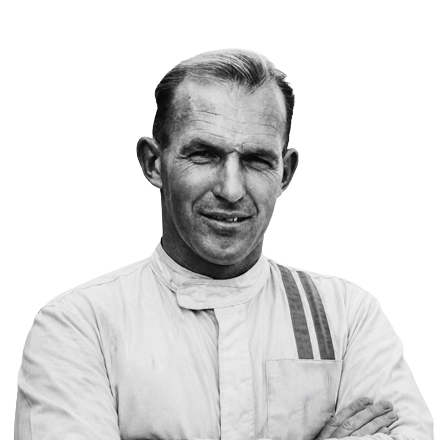
Frank Gardner OAM (1 October 1931 – 29 August 2009) was an Australian racing driver, engineer, team owner and motorsport manager whose career spanned more than four decades. Although he competed in Formula One during the 1960s, Gardner achieved his greatest success in touring cars, sports car racing and Formula 5000, winning the British Saloon Car Championship three times, the European Formula 5000 Championship, and the 1972 New Zealand Grand Prix.
Following his driving career, Gardner became one of Australia’s most successful team managers, leading BMW to multiple touring car championships and the famous 1988 Bathurst 1000 victory.
Driver Bio
| Nationality | Australian |
| Birthplace | Sydney, Australia |
| Born | 1 October 1930 |
| Died | 29 August 2009 |
| First Grand Prix | 1964 British Grand Prix |
| Last Grand Prix | 1968 Italian Grand Prix |
| Years Active | 1964–1965, 1968 |
| Current/Last Team | Privateer: Bernard White Racing BRM |
Early Life
Born in Sydney on 1 October 1931, Gardner grew up in modest circumstances after his father, a fisherman, was killed in a road accident. He was subsequently raised by his uncle, Hope Bartlett, a renowned racing driver and golfer in Australia and New Zealand, who encouraged both his engineering ability and passion for motorsport.
Before turning to racing, Gardner excelled in several sports. He was an accomplished boxer and won the Australian Surf Boat Championship in 1953 while representing Whale Beach Surf Life Saving Club.
After successfully competing in Australia with Jaguar XK120, C-Type and D-Type sports cars, Gardner travelled to England in 1958 to pursue a professional motorsport career.
Racing Career
Gardner initially hoped to work for Jaguar as an engineer before joining Aston Martin as a racing mechanic. He was part of the Aston Martin team that secured victory at the 1959 24 Hours of Le Mans, where one of his engineering recommendations—switching to a Colotti gearbox—proved instrumental in the winning car’s success.
He later joined the Jim Russell Racing Drivers’ School, preparing the cars before earning recognition as one of its standout instructors and drivers. His talent also saw him become the first employee recruited by Jack Brabham for the newly formed MRD team, which would later become the famous Brabham Formula One operation.
Formula One Career
Gardner competed in nine Formula One World Championship Grands Prix between 1964 and 1968. Although he never scored World Championship points, he established himself as a highly respected competitor through numerous appearances in non-championship Formula One races.
Among his strongest performances were third place in the 1965 Mediterranean Grand Prix at Pergusa, fourth in the 1965 Race of Champions at Brands Hatch and third in the 1971 International Gold Cup at Oulton Park.
Gardner also became a regular competitor in the Tasman Series, racing against many of Formula One’s greatest names, including Jim Clark, Graham Hill and Jochen Rindt. His finest achievement in the series came in 1972 when he won the New Zealand Grand Prix at Pukekohe driving a Lola T300-Chevrolet.
Sports Cars and Formula 5000
Alongside Formula One, Gardner enjoyed an outstanding international sports car career.
He claimed a class victory at the 1961 24 Hours of Le Mans alongside David Hobbs in a works Lotus Elite and later became a regular Ferrari and Porsche competitor in the World Sportscar Championship.
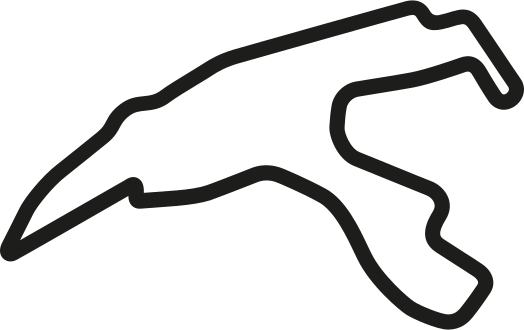
In 1966 he finished second at the 1000 km of Spa, while in 1969 he played an important role in the early development of the Porsche 917. At the Nürburgring 1000 km, Gardner partnered David Piper to bring the notoriously difficult new machine home in eighth place, recording the Porsche 917’s first-ever race finish after many factory drivers had declined to race it.
Gardner also competed internationally in Formula Two, finishing runner-up in both the European Trophy for Formula Two Drivers and the British Autocar Formula Two Championship in 1967.
His greatest single-seater success came in Formula 5000. After finishing fourth in the 1970 European Formula 5000 Championship, he captured the title in 1971 before winning the New Zealand Grand Prix the following season.
Touring Car Success
Gardner became one of the most successful touring car drivers of his era.
He won the British Saloon Car Championship three times, taking the titles in 1967, 1968 and 1973 with Ford and Chevrolet machinery. He also finished runner-up in the 1970 championship and regularly competed in endurance events, including a second-place finish at the 1975 Hardie-Ferodo 1000 at Bathurst alongside Bob Morris.
His versatility also took him to North America, where he raced in the inaugural Trans-Am Championship in 1966, winning the Under-2-litre class at Riverside in a Lotus Cortina. In 1968, he added a NASCAR start at Rockingham, further demonstrating his willingness to compete in virtually every form of circuit racing.
Team Owner and Manager
After returning permanently to Australia during the mid-1970s, Gardner initially continued racing, winning the 1977 Australian Sports Sedan Championship in a heavily modified Chevrolet Corvair.
He soon moved into team management, first running Allan Grice’s operation before establishing what became the famous JPS Team BMW. Under Gardner’s leadership, BMW became one of Australia’s dominant touring car forces during the 1980s.
The team won the Australian Touring Car Championship in 1985 and 1987 with Jim Richards, claimed multiple endurance victories and later secured the 1988 Bathurst 1000 with Tony Longhurst and Tomas Mezera in a Ford Sierra RS500 after Gardner began working with Longhurst’s team.
When BMW returned to Australian touring car racing in the 1990s, Gardner again led the factory effort, overseeing Australian Super Touring Championship titles in 1994, 1995 and 1997. He remained at the helm until retiring from full-time team management in 1998.
Engineering and Other Activities
Gardner’s engineering knowledge was one of the defining features of his career and contributed significantly to both his own success and that of the teams he managed.
Away from competition, he became a passionate advocate for advanced driver training. In 1990 he founded the Frank Gardner Performance Driving Centre in Queensland, helping thousands of drivers improve their road and circuit skills.
A respected author and public speaker, Gardner also shared his extensive knowledge through books including Racing Driver’s Manual (1973) and Drive to Survive (1980), both of which combined technical instruction with stories from his own racing career.
In recognition of his outstanding contribution to Australian motorsport, he was awarded the Medal of the Order of Australia (OAM).
Legacy
Throughout his life, Gardner often remarked that his ambition was not to be the fastest racing driver, but the oldest—a philosophy shaped by competing during one of motorsport’s most dangerous eras, when many close friends, including Formula One World Champion Jim Clark, lost their lives.
Frank Gardner died at his home in Mermaid Waters, Queensland, on 29 August 2009 following a long illness. He was 77 years old.
Remembered as a gifted driver, accomplished engineer and inspirational team manager, Gardner left a lasting mark on international motorsport. His achievements stretched from Formula One and Le Mans to touring cars, Formula 5000 and Australian Supercars, making him one of Australia’s most influential figures in racing history.
Grand Prix Stats
| Race Entries | 9 |
| Race Starts | 8 |
| Did Not Start | 0 |
| Best Race Start | 11th |
| Best Race Finish | 8th |
| Retirements | 5 |
| First-Lap Retirements | 2 |
| Not Classified | 0 |
| Disqualified | 0 |
| Did Not Qualify | 1 |
Qualifying
| Qualifying Sessions | 9 |
| Reached Q3 | 0 |
| Q2 Eliminations | 0 |
| Q1 Eliminations | 0 |
| Did Not Qualify | 1 |
Stats by Season
| Year | Constructor | Entries | Starts | Wins | Podiums | Poles | Fastest Laps | Front Rows | DNF | Best Start | Best Result | Pts Finishes | Points | Championship |
|---|---|---|---|---|---|---|---|---|---|---|---|---|---|---|
| 1964 | Privateer: John Willment Automobiles Brabham | 1 | 1 | 0 | 0 | 0 | 0 | 0 | 1 | 19 | – | 0 | 0 | NC |
| 1965 | Privateer: John Willment Automobiles Brabham | 7 | 7 | 0 | 0 | 0 | 0 | 0 | 4 | 11 | 8 | 0 | 0 | NC |
| 1968 | Privateer: Bernard White Racing BRM | 1 | 0 | 0 | 0 | 0 | 0 | 0 | 0 | – | – | 0 | 0 | NC |
Stats by Constructor
| Constructor | Years | Entries | Starts | Wins | Podiums | Poles | Fastest Laps | Front Rows | DNF | Best Start | Best Result | Pts Finishes | Points |
|---|---|---|---|---|---|---|---|---|---|---|---|---|---|
| Privateer: John Willment Automobiles Brabham | 1964–1965 | 8 | 8 | 0 | 0 | 0 | 0 | 0 | 5 | 11 | 8 | 0 | 0 |
| Privateer: Bernard White Racing BRM | 1968 | 1 | 0 | 0 | 0 | 0 | 0 | 0 | 0 | – | – | 0 | 0 |
Teammates & Qualifying Head-to-Head
| Teammate | Years | Races | Qualifying H2H |
|---|---|---|---|
| Paul Hawkins | 1965 | 1 | – |