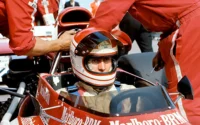























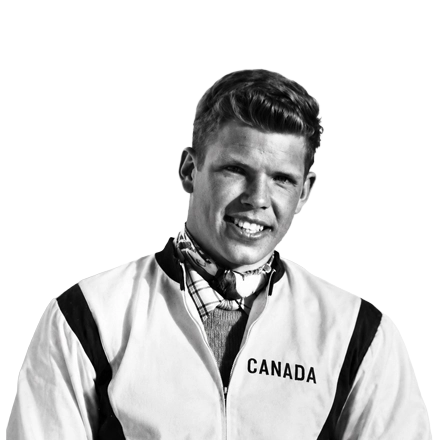
Peter Barry Ryan was one of motorsport’s great lost talents — a fearless young racer whose rise through international competition was as rapid as it was tragically brief. Born in the United States but proudly associated with Canada, Ryan became the first Canadian ever to compete in a Formula One World Championship Grand Prix and was widely regarded as a future star before his death at just 22 years old.
Driver Bio
| Nationality | Canadian |
| Birthplace | Philadelphia, Pennsylvania, USA |
| Born | 10 June 1940 |
| Died | 2 July 1962 |
| First Grand Prix | 1961 United States Grand Prix |
| Last Grand Prix | 1961 United States Grand Prix |
| Years Active | 1961 |
| Current/Last Team | Privateer: Lotus |
Born on 10 June 1940 in Mont-Tremblant, Quebec, Ryan initially looked destined for a completely different sporting career. As a teenager he emerged as a highly promising downhill skier, winning the National Ski Association’s junior downhill championship at Mount Rose, Nevada, in 1957. His success immediately sparked controversy when American competitors protested that a Canadian should not be allowed to win an American title — a complaint that was ultimately rejected.
Ryan’s skiing talent was so significant that both Canada and the United States became interested in securing him for Olympic competition. Born in the United States to American parents but raised within Canada’s ski culture, Ryan found himself caught between two national identities. Although he expressed a preference to represent Canada, he reportedly had no desire to surrender his American citizenship.
His future on the slopes ended abruptly after a devastating skiing accident in which he broke both legs. Rather than retreat from competitive sport, Ryan redirected his energy toward motor racing — a decision that would reveal astonishing natural talent behind the wheel.
He first entered racing in 1959 after purchasing a beautifully prepared Porsche 550 previously owned by Bernie Vihl. At just 19 years old, Ryan quickly adapted to sports car competition, building a reputation for fearlessness and speed across Canada, the United States and the Bahamas.
Success came rapidly. In October 1960, Ryan partnered Roger Penske to victory in the six-hour Sundown Grand Prix at Harewood, Ontario, driving a Porsche RS60. Just days later at Watkins Glen, he stunned observers during qualifying for a Formula Libre race by securing fifth place on the grid ahead of established international stars including Roy Salvadori. Only Stirling Moss, Jack Brabham, Jo Bonnier and Olivier Gendebien qualified faster.
Driving Bill Sadler’s famously wild “Formula Ferocious” special, Ryan demonstrated that he could immediately compete with world-class opposition.
His endurance racing credentials also grew quickly. At Sebring in 1961, Ryan teamed with Frances Bradley and Ludwig Heimrath to finish eighth overall in the gruelling 12 Hours of Sebring aboard a Porsche RS. Around the same period he became involved in the growing tensions between amateur and professional racing regulations in North America, even withdrawing from a Canadian race after concerns that accepting prize money could jeopardise his Sports Car Club of America amateur status.
By mid-1961 Ryan was attracting serious international attention. At the Meadowdale Grand Prix he fought an intense duel with Roger Penske before finishing second after being hit from behind during the race. Only weeks later he claimed victory in the Vanderbilt Cup Formula Junior race at Bridgehampton driving a Lotus 20, averaging nearly 88 mph.
Then came the result that changed everything.
On 30 September 1961, Ryan won the inaugural Canadian Grand Prix at Mosport Park driving a Lotus Monte Carlo-Climax. Although the race was not yet part of the Formula One World Championship, the field included major international stars. Ryan defeated both Pedro Rodríguez and Stirling Moss in one of the most significant victories by a Canadian driver to that point.
The performance impressed Lotus founder Colin Chapman enough to offer Ryan a Formula One opportunity at the 1961 United States Grand Prix at Watkins Glen. Ryan finished ninth on his World Championship debut, becoming the first Canadian driver ever to compete in Formula One.
His career momentum continued into 1962. Ryan raced at Daytona, Sebring and Le Mans while also securing a coveted Formula Junior programme in Europe linked to Team Lotus. Although an anticipated full works Lotus drive failed to materialise, Chapman still placed him under contract and loaned him to Ian Walker Racing for the season.
In Europe, Ryan’s reputation grew rapidly. At Monaco, he won a Formula Junior heat race, and respected journalist Denis Jenkinson praised his driving as “very impressive.” Days later at Mallory Park, Ryan defeated highly rated Lotus works driver Peter Arundell after shadowing him throughout the race before making a decisive late pass for victory.
Observers increasingly believed Ryan possessed the rare combination of aggression, speed and natural racecraft needed to become a major international star.
He made his Le Mans debut in June 1962, driving a Ferrari 250 TRI/61 for the North American Racing Team alongside John “Buck” Fulp. Although the race ended in retirement after Ryan crashed at Mulsanne, simply securing a Ferrari drive at Le Mans at such a young age reflected how highly he was already regarded within racing circles.
Tragically, his meteoric rise ended only days later.
Death
On 2 July 1962, during a Formula Junior race at Reims in France, Ryan became involved in a high-speed battle with Bill Moss, John Love, Peter Arundell and others. Exiting the ultra-fast Gueux bend, Ryan’s Lotus touched Moss’s Gemini and both cars left the road at enormous speed, being virtually destroyed in the accident.
Moss escaped with relatively minor injuries, but Ryan suffered catastrophic injuries and was transported to a hospital in Paris, where he later died. He was only 22 years old.
The shock of his death reverberated throughout the motorsport world. Many believed Ryan had the potential to become one of North America’s greatest international racing drivers. Journalist Peter Garnier later wrote that Ryan possessed “just that touch of fire which can often indicate the makings of a great driver.”
Though his career lasted only a few short seasons, Peter Ryan’s impact was historic. As the first Canadian Formula One driver and winner of the inaugural Canadian Grand Prix, he helped pave the way for future generations of Canadian racers on the world stage.
In recognition of his achievements and extraordinary promise, Ryan was inducted as an inaugural member of the Canadian Motorsport Hall of Fame in 1993.
Grand Prix Stats
| Race Entries | 1 |
| Race Starts | 1 |
| Did Not Start | 0 |
| Best Race Start | 13th |
| Best Race Finish | 9th |
| Retirements | 0 |
| First-Lap Retirements | 0 |
| Not Classified | 0 |
| Disqualified | 0 |
| Did Not Qualify | 0 |
Qualifying
| Qualifying Sessions | 1 |
| Reached Q3 | 0 |
| Q2 Eliminations | 0 |
| Q1 Eliminations | 0 |
| Did Not Qualify | 0 |
Stats by Season
| Year | Constructor | Entries | Starts | Wins | Podiums | Poles | Fastest Laps | Front Rows | DNF | Best Start | Best Result | Pts Finishes | Points | Championship |
|---|---|---|---|---|---|---|---|---|---|---|---|---|---|---|
| 1961 | Privateer: Lotus | 1 | 1 | 0 | 0 | 0 | 0 | 0 | 0 | 13 | 9 | 0 | 0 | NC |