

























Écurie Nationale Belge—more accurately titled Équipe Nationale Belge, and commonly abbreviated to ENB—was a Belgian racing team active in Formula One and sports car competition during the 1950s and 1960s. Formed through the merger of two respected Belgian operations, Jacques Swaters’ Écurie Francorchamps and Johnny Claes’ Écurie Belge, the team was created to give Belgium a stronger and more unified presence in international motorsport. It was an ambitious national project, blending talent, resources and racing prestige under one banner.
| First entry | 1955 Dutch Grand Prix |
|---|---|
| Races entered | 8 |
| Constructors | Ferrari Cooper-Climax Lotus-Climax Emeryson-Climax Emeryson-Maserati ENB-Maserati |
| Race victories | 0 |
| Pole positions | 0 |
| Fastest laps | 0 |
| Final entry | 1962 German Grand Prix |
ENB as a Formula One chassis constructor
| Entrants | Écurie National Belge |
|---|---|
| First entry | 1962 German Grand Prix |
| Last entry | 1962 German Grand Prix |
| Races entered | 1 |
| Race victories | 0 |
| Pole positions | 0 |
| Fastest laps | 0 |
Even after the merger, Écurie Francorchamps continued to operate independently, entering both factory-supported and privately owned Ferrari machinery. That meant Belgian motorsport in this era enjoyed something rare: multiple competitive pathways running side by side, often with overlapping people, ambitions and machinery.
Belgian roots and formation
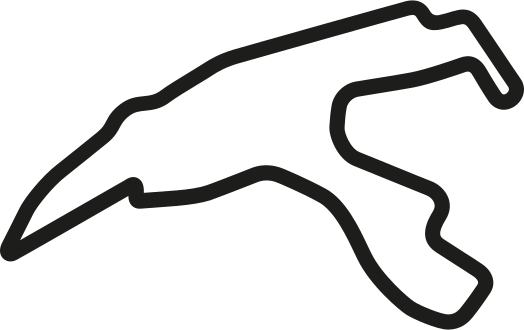
The creation of ENB reflected the growing confidence of post-war Belgian motorsport. Belgium already had one of Europe’s great circuits at Spa-Francorchamps, a thriving enthusiast culture, and several well-connected racing figures eager to compete internationally. By combining the experience of Jacques Swaters and Johnny Claes, the new team aimed to elevate Belgian representation beyond isolated private entries and into a more organised national effort.
It was not unusual in that era for teams to be driven as much by personality and patriotism as by corporate strategy. ENB carried both. It represented a country determined to compete with the established racing powers of Italy, Britain and France, even if budgets and resources were often more modest.
Formula One campaign
In Formula One, Écurie Nationale Belge adopted the flexible and pragmatic approach common to independent teams of the period. Rather than rely on a single constructor, the team entered a variety of chassis over the years depending on availability, competitiveness and opportunity. Its machinery included cars from Ferrari, Cooper, Lotus and Emeryson.
This mix-and-match strategy was typical of private entrants in the early Formula One era. Teams often had to be opportunistic, sourcing the best car they could afford or acquire rather than designing a complete programme around long-term factory support. ENB’s willingness to run different chassis showed adaptability and a determination to stay on the grid in a fast-changing sport.
The home-built ENB car
Most famously, the team also produced a car of its own construction, simply named the ENB. For a national private team, building an original Formula One chassis was no small undertaking. It represented confidence, engineering ambition and the desire to do more than rent competitiveness from larger manufacturers.
The ENB machine made a single World Championship appearance at the 1962 German Grand Prix. The car was designed by Jacques Coune, one of the team’s co-founders, adding a personal and distinctly Belgian stamp to the project. While it did not become a long-term contender, simply reaching the World Championship stage with an in-house design was a notable achievement for an independent operation.
Sportscar racing involvement
Like many European teams of the era, ENB’s interests extended beyond Formula One. Sports car racing offered additional opportunities to compete internationally, often with more accessible machinery and broader event calendars. Teams regularly moved between disciplines, and success in one category could strengthen reputation and finances in another.
For Belgian outfits in particular, endurance and GT racing were natural arenas, given the country’s central location and strong motorsport culture. ENB’s participation in both Formula One and sports cars reflected a versatile, all-round racing identity rather than a narrow single-series focus.
ENB Complete Formula One World Championship results
| Year | Chassis | Engine | Driver | 1 | 2 | 3 | 4 | 5 | 6 | 7 | 8 | 9 | 10 |
|---|---|---|---|---|---|---|---|---|---|---|---|---|---|
| 1955 | ARG | MON | 500 | BEL | NED | GBR | ITA | ||||||
| Ferrari 500 | Ferrari L4 | Johnny Claes | 11 | ||||||||||
| 1959 | MON | 500 | NED | FRA | GBR | GER | POR | ITA | USA | ||||
| Cooper T51 | Climax Straight-4 | Alain de Changy | DNQ | ||||||||||
| Lucien Bianchi | DNQ | ||||||||||||
| 1960 | ARG | MON | 500 | NED | BEL | FRA | GBR | POR | ITA | USA | |||
| Cooper T45 | Climax Straight-4 | Lucien Bianchi | 6 | ||||||||||
| 1961 | MON | NED | BEL | FRA | GBR | GER | ITA | USA | |||||
| Emeryson | Maserati Straight-4 | Olivier Gendebien | DNQ | ||||||||||
| Lucien Bianchi | DNQ | ||||||||||||
| Lotus 18 | Climax Straight-4 | Ret | |||||||||||
| Willy Mairesse | Ret | ||||||||||||
| Emeryson | André Pilette | DNQ | |||||||||||
| 1962 | NED | MON | BEL | FRA | GBR | GER | ITA | USA | RSA | ||||
| Lotus 18/21 | Climax Straight-4 | Lucien Bianchi | 9 | ||||||||||
| ENB | Maserati Straight-4 | 16 | |||||||||||


