







































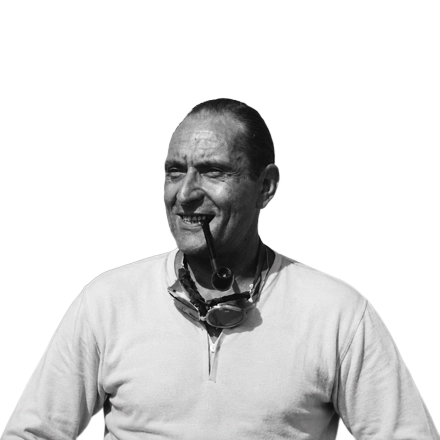
Felice Bonetto was one of the great daredevils of post-war Italian motor racing — fearless, spectacularly fast and utterly uncompromising behind the wheel. Nicknamed “Il Pirata” (“The Pirate”) for his aggressive driving style and swashbuckling personality, Bonetto became a fan favourite across Europe during the late 1940s and early 1950s, excelling in both Formula One and endurance racing before his life was tragically cut short at the height of his career.
Driver Bio
| Nationality | Italian |
|---|---|
| Birthplace | Manerbio, Italy |
| Born | 9 June 1903 |
| Died | 21 November 1953 (aged 50) Silao, Guanajuato, Mexico |
| Active years | 1950–1953 |
| Teams | Milano, Alfa Romeo, Maserati |
| Entries | 16 (15 starts) |
| Championships | 0 |
| Wins | 0 |
| Podiums | 2 |
| Career points | 17.5 |
| Pole positions | 0 |
| Fastest laps | 0 |
| First entry | 1950 Swiss Grand Prix |
| Last entry | 1953 Italian Grand Prix |
Born on 9 June 1903 in Manerbio, near Brescia — the spiritual home of the Mille Miglia — Bonetto grew up surrounded by Italy’s deep racing culture. Despite this, his path into motor racing was unconventional. He first competed on motorcycles and did not switch to cars until relatively late, making his four-wheel debut at the age of 28 in the Bobbio-Penice hill climb driving a Bugatti.
Even with machinery that was often outclassed, Bonetto quickly earned a reputation for bravery and raw speed. In 1933 he achieved one of his first major results by finishing third in the notorious Gran Premio di Monza driving an Alfa Romeo 8C 2600. The race became infamous as the “Black Day of Monza” after the deaths of Giuseppe Campari, Mario-Umberto Borzacchini and Count Stanisław Czaykowski within a matter of hours — a grim reminder of the danger that defined Grand Prix racing during the era.
Before the Second World War interrupted European motorsport, Bonetto also recorded strong performances in events such as the Coppa Principessa di Piemonte and the Mille Miglia, where he finished 12th in 1934. When racing resumed after the war, he returned with renewed determination, initially driving for Cisitalia before moving into the emerging world of Formula One.
Although he had already raced Grand Prix machinery earlier in his career, Bonetto officially made his Formula One World Championship debut at the 1950 Swiss Grand Prix — just five days before his 47th birthday. Competing under the Scuderia Milano banner in his own Maserati 4CLT, he immediately became one of the oldest and most experienced drivers on the grid.
In 1951 he joined Alfa Romeo as the team’s third driver, racing alongside some of the sport’s greatest names. That season he scored his first Formula One podium by sharing third place with Giuseppe Farina at the Italian Grand Prix. He later returned to Maserati machinery and enjoyed another strong World Championship campaign in 1953, again taking a shared podium finish — this time at the Dutch Grand Prix alongside José Froilán González.
Across his Formula One career, Bonetto competed in 16 World Championship Grands Prix between 1950 and 1953, earning two podium finishes and becoming one of the sport’s most respected veterans.
Yet it was in sports car racing where Bonetto truly flourished.
Throughout the late 1940s and early 1950s he established himself as one of Europe’s elite endurance racers. He won the Circuito di Firenze in 1947 driving a Delage and finished second in the 1949 Mille Miglia for Ferrari, only beaten by the legendary Clemente Biondetti. In 1950 he claimed victory in the Pontedecimo-Giovi hill climb in an Osca and triumphed at the Gran Premio di Oporto in his privately entered Alfa Romeo.
Bonetto’s finest hour came in 1952 after joining Scuderia Lancia. Driving the elegant Lancia Aurelia B20, he achieved victory in the legendary Targa Florio — one of the toughest and most prestigious road races in the world. The triumph cemented his status as one of Italy’s greatest sports car drivers of the era.
He remained a key figure in Lancia’s factory squad throughout 1953, taking third in the Mille Miglia, second in the Gran Premio di Monza and victory in the Grande Premio do Jubileu in Portugal. By then, Lancia’s driver line-up was extraordinary, featuring Bonetto alongside Juan Manuel Fangio, Piero Taruffi, Giovanni Bracco and Eugenio Castellotti.
That formidable team travelled to Mexico for the 1953 Carrera Panamericana — perhaps the most dangerous road race in the world. Spanning roughly 2,000 miles over six brutal days, the event pushed both drivers and machines to their absolute limits across high-speed public roads.
Bonetto immediately established himself as the man to beat, winning the opening stage ahead of his Lancia teammates. Alongside Taruffi, he controlled much of the event and remained in contention for overall victory deep into the race.
Death
But on 21 November 1953, tragedy struck.
Near the town of Silao, after Taruffi had already crashed in foggy conditions, Bonetto lost control of his Lancia while attacking a corner at extraordinary speed. His car slammed into the balcony of a house before striking a lamp post. Bonetto suffered fatal head injuries instantly.
In a haunting detail that perfectly captured both his bravery and the recklessness of the era, Bonetto and several fellow Italian drivers had reportedly marked dangerous corners along the route with blue warning signs before the race. The corner where he crashed was one of those marked locations — yet Bonetto still attacked it at nearly double the suggested speed.
Following his death, Gianni Lancia initially wanted to withdraw the team from the event, but the surviving drivers chose to continue in honour of their fallen teammate. Fangio, Taruffi and Castellotti ultimately secured a dominant 1-2-3 finish for Lancia, though the victory was overshadowed by multiple fatalities, including Bonetto’s.
He was buried in the Italian cemetery section of the Panteón Civil de Dolores in Mexico City.
Bonetto’s influence extended beyond racing itself. His nephew, Rodolfo Bonetto, became one of Italy’s leading industrial designers and architects, while his son Roberto Bonetto later built a respected career in automotive journalism, eventually becoming deputy editor of Quattroruote magazine.
Remembered as both a brilliant racer and one of motorsport’s great risk-takers, Felice Bonetto embodied the fearless spirit of post-war racing — an era when courage often mattered just as much as machinery, and when drivers like “Il Pirata” lived every lap on the edge.
Complete Formula One World Championship results
| Year | Entrant | Chassis | Engine | 1 | 2 | 3 | 4 | 5 | 6 | 7 | 8 | 9 | WDC | Points |
|---|---|---|---|---|---|---|---|---|---|---|---|---|---|---|
| 1950 | Scuderia Milano | Maserati 4CLT/50 | Maserati Straight-4 | GBR DNA | MON | 500 | SUI 5 | BEL | FRA Ret | 19th | 2 | |||
| Milano Speluzzi | ITA DNS | |||||||||||||
| 1951 | Alfa Romeo SpA | Alfa Romeo 159A | Alfa Romeo Straight-8 | SUI | 500 | BEL | FRA | GBR 4 | GER Ret | ITA 3 | 8th | 7 | ||
| Alfa Romeo 159M | ESP 5 | |||||||||||||
| 1952 | Officine Alfieri Maserati | Maserati A6GCM | Maserati Straight-6 | SUI | 500 | BEL | FRA | GBR | GER DSQ | NED | ITA 5 | 16th | 2 | |
| 1953 | Officine Alfieri Maserati | Maserati A6GCM | Maserati Straight-6 | ARG Ret | 500 | NED 3‡ | BEL | FRA Ret | GBR 6 | GER 4 | SUI 4† | ITA Ret | 9th | 6.5 |
† Shared drive with Juan Manuel Fangio