



























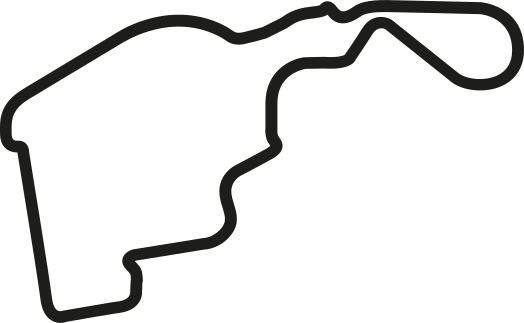
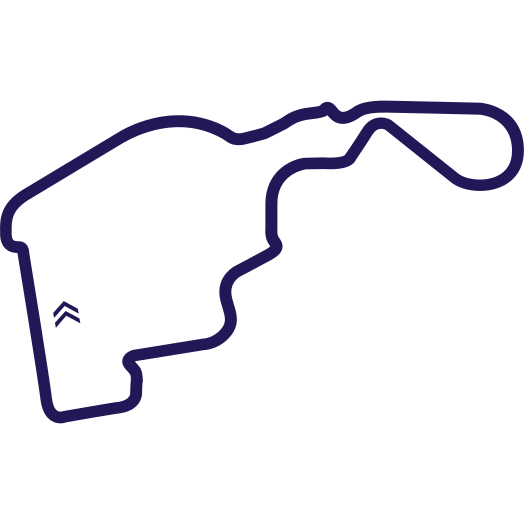
The Formula 1 Spanish Grand Prix changed venues in 2026, moving to a newly constructed circuit surrounding the IFEMA exhibition centre in Madrid.
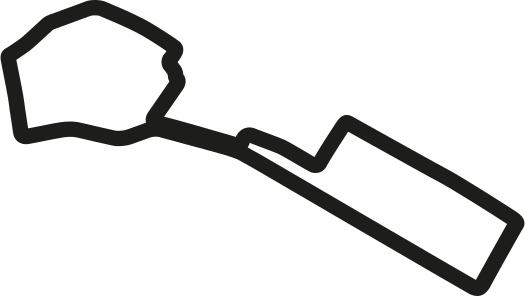
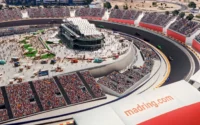
This new track, stretching 5.416 kilometres, combines elements of a street circuit and a permanent race track. It features 22 turns, with the pit and paddock areas integrated into the exhibition centre’s halls. The standout section of the track is the permanent steeply banked, sweeping curve, called La Monumental. It is the “longest banked curve” in Formula One.
The track’s final design was guided by Italy’s Dromo company and was still being completed right up to the main sessions of the opening race, the 2026 Spanish Grand Prix.
On 10 March 2025, a full season ahead of its debut, race promoters announced the track would be named “Madring” explaining:
“Formula 1 circuits are typically referred to by the city or region where they are located – Monza, Imola, Interlagos, Spa, Silverstone, Miami, Las Vegas,” they said in a statement. “However, their full official names are rarely used. For this reason, Madring aims to establish a concise and memorable identity that directly references its host city, is instantly recognisable worldwide, and requires no translation.”
“Ultimately, it is more than just a name — it is a genuine, distinctive, and iconic brand, designed to resonate with a modern and engaged F1 audience,” they added.
See also…
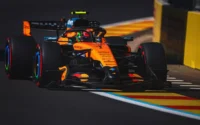
Come 12 September 2026, Lando Norris took pole at the 2026 Spanish Grand Prix, becoming the first driver to do so at the Circuito de Madrid, F1’s newest circuit.
Circuito de Madring
| First Grand Prix | 2026 Spanish Grand Prix |
| Number of Laps | 57 |
| Circuit Length | 5.416 km (3.365 mi) |
| Race Distance | 308.524km (191.708 miles) |
| Lap Record | 1:31.824* |
Circuit
When was the Circuito de Madring built?
Speculation about moving the Formula One Spanish Grand Prix from Barcelona to Madrid, which last hosted a race in 1981, was rife for a while. Madrid, eager to reclaim its place in F1, was seen as a prime candidate. Formula One’s preference for city centre races ruled out the Jarama permanent circuit from consideration.
In 2022, serious planning for a Madrid Grand Prix commenced, culminating in a January 2024 announcement of a 10-year agreement with the IFEMA Madrid exhibition centre to host the event from the 2026 F1 World Championship. This agreement replaced the Circuit de Barcelona-Catalunya after its current contract expired, replaced with the Barcelona-Catalunya Grand Prix.
The proposed circuit covers two main areas: the existing IFEMA site with its halls, auditoriums, and convention centres, and the Valdebebas area in the north, close to Real Madrid’s Sports City football training grounds.
Pits and paddocks are set up temporarily within FEMA’s exhibition halls, while a permanent track section was created on undeveloped land. That section includes the high-speed, La Monumental banked turn reminiscent of the historic Sitges track.
Throughout the planning stages, F1 and IFEMA representatives consulted extensively, involving Jarno Zaffelli, a renowned circuit designer from the Italian firm Dromo, to refine the design. The outcome was the 5.416 km (3.365 mi) circuit with 22 turns and an estimated qualifying lap time of approximately 1 minute and 32 seconds.
Is the Circuito de Madring environmentally sustainable?
A central aspect of the announcement for the new circuit and race in Madrid was the commitment to environmental sustainability. With F1’s drive for net zero by 2030, becoming a sustainable circuit was high on the agenda.
The circuit incorporates street and traditional track elements and is conveniently accessible via Madrid’s existing public transport network. F1 and IFEMA anticipate that up to 90% of spectators can reach the venue by public transport or on foot.
The circuit is designed to accommodate approximately 110,000 spectators daily, with plans to increase this capacity to about 140,000 over the first five years of the contract.
For international visitors, the circuit’s location in the Barajas district offers easy access. It’s situated near the Adolfo Suarez Airport, only 16 kilometres from Madrid’s city centre, and is well-connected by car, bus, train, and subway.
A significant environmental benefit is the onsite storage of the circuit’s temporary infrastructure. This proximity not only reduces the carbon footprint by eliminating the need for transportation from distant storage locations but also simplifies the annual event setup. IFEMA’s approach positions Madrid to host what they claim to be the first ‘zero-kilometre Grand Prix’.
When was the first Spanish Grand Prix?
The Spanish Grand Prix is one of the most historic races in Formula One and celebrated its 100th anniversary in 2013; it first appeared in 1913, long before becoming a championship race.
Spain joined the Formula One championship in 1951 at Barcelona’s Pedralbes street circuit. Argentine Juan Manuel Fangio clinched his first world championship there in 1951, driving an Alfa Romeo. Although the race was planned for 1952 and 1953, financial constraints led to its cancellation. In 1954, the race returned for one more year but was cancelled again in 1955 following a catastrophic accident at the 24 Hours of Le Mans, which resulted in more than 80 fatalities and led to new spectator safety regulations. Characterised by its width and proximity to pedestrians, it was never used again for motor racing.
The Spanish Grand Prix has seen races held at the Montjuïc circuit, situated within the city limits of Barcelona, and was the site of the Spanish Grand Prix between 1969 and 1975. The Jarama circuit between 1976 and 1981 and then Jerez from 1986 to 1990.
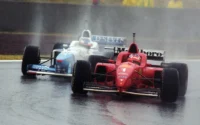
The Circuit de Barcelona-Catalunya, which began hosting the Spanish Grand Prix in 1991, made a dramatic entrance onto the Formula 1 stage with its first race, featuring a memorable showdown between Nigel Mansell and Ayrton Senna. This race is particularly renowned for a breathtaking moment between the two F1 legends engaged in an intense, wheel-to-wheel battle along the circuit’s main straight.
In what can only be described as a high-speed, eyeball-to-eyeball duel, Mansell and Senna raced down the straight with mere inches separating their cars. The moment was a spectacular display of skill, nerve, and competitive spirit, showcasing two of the sport’s greatest drivers at their best. The tension and excitement of this head-to-head moment captivated fans and highlighted the potential of the Circuit de Barcelona-Catalunya as a venue for thrilling motorsport action.
Mansell, in his Williams car, ultimately overtook Senna and took control of the race. His performance led him to victory and cemented the race as a classic moment in Formula 1 history. This duel, and Mansell’s subsequent win, set a high standard for the races that followed at the Circuit de Barcelona-Catalunya, marking it as a circuit capable of delivering some of the most exhilarating moments in racing.
Starting in 2026, Madrid will become the new location for the Spanish Grand Prix, hosting the event on an innovative part-street circuit, the Circuito de Madring.
Circuito de Madring lap record
The official lap record for the F1 Grand Prix Circuito de Madring layout was set during qualifying with a time of 1:31.824 by Lando Norris driving for McLaren at the 2026 Spanish Grand Prix.