

























Patrick Bruce Reith Symonds (born 11 June 1953) is one of Formula One’s most respected engineering figures, with a career spanning more than four decades at the highest level of motorsport. The British engineer currently serves as Executive Engineering Consultant for the Cadillac Formula One Team, helping shape the American manufacturer’s entry into the championship.
Before joining Cadillac, Symonds held several of the sport’s most influential technical positions. He was Williams Racing‘s Chief Technical Officer between 2013 and 2016, having previously played major engineering and leadership roles at Toleman, Benetton, Renault and Virgin/Marussia. From 2017 until May 2024, he also served as Formula One’s Chief Technical Officer, helping steer the sport’s technical future.
| Born | Patrick Bruce Reith Symonds 11 June 1953 Bedford, England, United Kingdom |
|---|---|
| Education | Master’s in Vehicle Dynamics |
| Alma mater | Cranfield University Oxford Polytechnic |
| Years active | 1980s–present |
Symonds first made his mark in junior motorsport before joining Toleman at the end of the 1970s. Aside from a brief spell working on the ultimately unsuccessful Reynard Formula One project alongside long-time collaborator Rory Byrne in 1991, the majority of his early career was spent with the Enstone-based team as it evolved from Toleman into Benetton and later Renault.
Throughout that remarkable journey, Symonds became one of the key architects behind some of Formula One’s greatest successes. He played a central role in Michael Schumacher‘s championship-winning campaigns in 1994 and 1995 before helping Fernando Alonso secure consecutive world titles in 2005 and 2006. Teams he worked with claimed four Drivers’ Championships, three Constructors’ Championships and 42 Grand Prix victories during his tenure — 22 with Benetton and a further 20 with Renault.
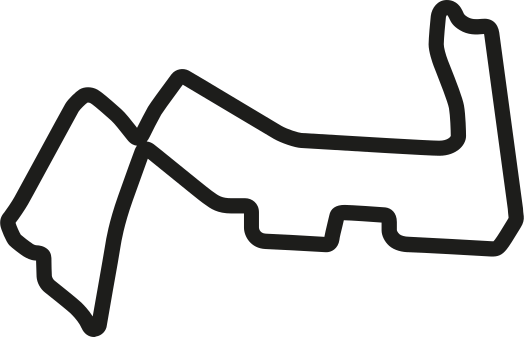
One of the defining moments of Symonds’ career came in 2009 following the investigation into the 2008 Singapore Grand Prix “Crashgate” controversy. He resigned from Renault after the allegations emerged and was subsequently banned from operational Formula One roles for three years by the FIA, although he remained eligible to work in a consultancy capacity. Renault Managing Director Flavio Briatore received an indefinite FIA ban at the same time. Both sanctions were later overturned by a French court.
Early Life
Patrick Symonds was born in Bedford, England, on 11 June 1953. He attended Gresham’s School in Holt, Norfolk, before studying automotive engineering at Cranfield Institute of Technology and Oxford Polytechnic. He later completed a Master’s degree in Vehicle Dynamics at Cranfield University’s Institute of Technology in 1976, laying the foundations for what would become one of Formula One’s most accomplished engineering careers.
Career
Ford and Toleman
Symonds’ motorsport career began with the Ford Motor Company, where he worked as an undergraduate apprentice. He then joined racing car manufacturer Hawke, designing Formula Ford machinery before moving to Royale Racing. It was there that he formed a successful working relationship with designer Rory Byrne, with the pair collaborating on Formula Ford projects.
In 1979, Symonds joined Toleman, just as the team was establishing itself as one of the leading forces in European Formula Two. Working alongside Hart Racing Engines, Toleman enjoyed immediate success, with Brian Henton and Derek Warwick dominating the 1980 European Formula Two Championship by finishing first and second overall.
As Toleman prepared for its move into Formula One, Symonds focused on research and development while simultaneously serving as race engineer to Stefan Johansson in the team’s Formula Two programme run by Docking Spitzley Racing. By the early 1980s, he had become a full-time Formula One race engineer, working with Derek Warwick and Teo Fabi in 1982, Bruno Giacomelli in 1983 and, most famously, rookie Ayrton Senna during the Brazilian’s sensational debut season in 1984.
Benetton and Renault
When Toleman evolved into Benetton Formula and later Renault F1 Team, Symonds remained at Enstone throughout every transformation, steadily climbing the engineering ladder.
He engineered several leading drivers, including Alessandro Nannini and Teo Fabi, before briefly leaving in 1991 to join Rory Byrne on Adrian Reynard’s planned Formula One project. Although the ambitious programme never reached the grid, Symonds and Byrne returned to Benetton after technical director John Barnard departed following disagreements with team principal Flavio Briatore.
By the mid-1990s, Symonds had become Michael Schumacher‘s race engineer, helping guide the German to back-to-back World Championships in 1994 and 1995. Alongside his trackside responsibilities, he also led Benetton’s Research and Development department.
After Schumacher moved to Ferrari in 1996 and Ross Brawn followed a year later, Symonds was promoted to Technical Director. In 2001, following the arrival of Mike Gascoyne, he stepped into the role of Executive Director of Engineering, retaining the position through Renault’s takeover of the team in 2002. Even after Bob Bell replaced Gascoyne, Symonds remained one of the organisation’s senior technical leaders.
His influence reached another peak in 2005 and 2006 when Renault, with Fernando Alonso at the wheel, secured consecutive Drivers’ and Constructors’ Championship success, ending Ferrari’s era of dominance.
Crashgate
In July 2009, Nelson Piquet Jr. alleged that Symonds had instructed him to deliberately crash during the 2008 Singapore Grand Prix in order to create circumstances that would benefit teammate Fernando Alonso.
Renault announced in September 2009 that Symonds had left the team, bringing to an end nearly three decades with the Enstone organisation. Following an FIA investigation, Symonds acknowledged his involvement in the conspiracy, expressed what he described as his “eternal regret and shame”, and received a five-year suspension from attending Formula One events.
The sanction was overturned in January 2010 by the French Tribunal de Grande Instance, which also awarded Symonds €5,000 in compensation. A subsequent settlement with the FIA allowed him to return to Formula One in a full operational role from 2013, while consultancy work remained permitted beforehand.
Virgin/Marussia and Williams
Symonds returned to Formula One in 2011 as a consultant to Virgin Racing, later known as Marussia F1 Team. Brought in to review the team’s technical operation after a disappointing start to the season, he played a major role in reshaping the organisation following the departure of technical director Nick Wirth. Although widely viewed as the team’s technical leader, the terms of his FIA agreement meant he officially remained a consultant throughout this period.
Away from the pit wall, Symonds also shared his technical expertise as a columnist for F1 Racing magazine.
In July 2013, Williams Racing announced Symonds as its new Chief Technical Officer, replacing Mike Coughlan. His impact was immediate. After finishing ninth in the Constructors’ Championship in 2013, Williams climbed to third in both 2014 and 2015 before securing fifth place in 2016. Symonds left the Grove-based team at the end of that season following the expiry of his contract.
Formula One Chief Technical Officer
Symonds’ influence extended beyond individual teams when he joined Formula One Management as Chief Technical Officer in March 2017.
Alongside his new position, he also became a member of the Motorsport Engineering and Management MSc committee at Cranfield University and joined Sky Sports F1 as a technical analyst, helping explain the sport’s increasingly complex engineering to television audiences.
As Formula One’s Chief Technical Officer, Symonds was instrumental in developing the sweeping 2022 technical regulations, including the return of ground-effect cars designed to improve wheel-to-wheel racing. He also contributed to the development of the sport’s 2026 regulations before stepping down from the role in May 2024.
Cadillac
In May 2024, Symonds was announced as Executive Engineering Consultant for Andretti Global’s Formula One project, which has since become the Cadillac Formula One Team.
His appointment placed one of Formula One’s most experienced engineering minds at the centre of Cadillac’s preparations for its planned entry into the FIA Formula One World Championship in 2026, bringing decades of technical leadership and championship-winning experience to one of the sport’s most ambitious new projects.
Seen in: