






















The 2007 FIA Formula One World Championship marked the 58th running of the championship, unfolding across seventeen races from 18 March to 21 October. It delivered one of the most dramatic title deciders in F1 history, culminating in a last-race showdown that saw Ferrari’s Kimi Räikkönen snatch the 2007 Drivers’ Championship by a single point. In doing so, Räikkönen became the third Finnish world champion, joining an elite national lineage.
Season
The outcome of the championship was not without controversy. McLaren lodged an appeal following the final race, questioning the legality of certain cars and raising the possibility of a revised championship classification. However, on 16 November, the International Court of Appeal dismissed the case, formally confirming Kimi Räikkönen as world champion. Remarkably, he had arrived at the final round only third in the drivers’ standings, yet emerged as champion once the chequered flag fell — a comeback scenario last achieved by Giuseppe Farina in the inaugural 1950 championship.
Off track, the season was dominated by one of Formula One’s most infamous scandals: the espionage affair involving Ferrari and McLaren. The controversy ultimately resulted in McLaren being excluded from the 2007 Constructors’ Championship altogether, a seismic decision that handed Ferrari the title early, which they secured at the 2007 Belgian Grand Prix. The fallout reshaped the competitive order, pushing defending double Constructors’ Champions Renault into third place in the standings following McLaren’s exclusion. Renault endured a difficult campaign with the R27, failing to score a single race win for the first time since 2002. Their lone podium came courtesy of Heikki Kovalainen, who finished second in a rain-soaked 2007 Japanese Grand Prix.
Beyond the battles on track, 2007 represented a pivotal year in Formula One’s political and technical evolution. It marked the final season governed by the existing Concorde Agreement between the teams and Bernie Ecclestone. At the centre of the negotiations were Mercedes-Benz, BMW, and Honda — operating collectively under the Grand Prix Manufacturers’ Association — who were locked in disputes with both the FIA and Ecclestone over financial and regulatory matters. The standoff grew serious enough that the manufacturers threatened to form a rival championship from 2008 onward, before tensions eased with the signing of a memorandum of understanding at the 2006 Spanish Grand Prix.
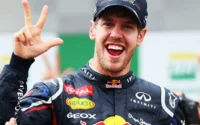
Technologically, the season also closed an era. 2007 was the seventh and final year since its reintroduction in 2001 that traction control was permitted in Formula One. From 2008, FIA-mandated standardised electronic control units would outlaw such driver aids entirely. The year also introduced two drivers who would go on to define a generation: rookies Lewis Hamilton and Sebastian Vettel, both made their Formula One debuts.
Visually and symbolically, Honda made headlines by running a striking “Earth livery” on their RA107. It was the first time since 1968 — before commercial sponsorship became ubiquitous in the sport — that a team competed for an entire season without a sponsor’s branding on its car. Meanwhile, Michelin’s departure from Formula One at the end of 2006 left Bridgestone as the sole tyre supplier for 2007, returning the championship to a single-manufacturer format last seen in 1999 and 2000.
In historical context, the significance of the season has only grown. As of 2025, the 2007 championship remains the most recent Drivers’ title won by a Ferrari driver — and the last secured by a Finnish driver — underscoring just how enduring and singular Kimi Räikkönen’s triumph ultimately proved to be.
2007 F1 Entries Drivers and Teams
The teams and drivers listed below competed in the 2007 FIA Formula One World Championship. Car numbers are shown exactly as they appeared on the official FIA 2007 entry list. Team information follows the Formula 1 official website unless otherwise stated. In keeping with long-standing Formula One tradition, car number 13 was not allocated. Throughout the season, every team ran on Bridgestone tyres, following Michelin’s withdrawal from the championship at the end of 2006.
| Entrant | Constructor | Chassis | Engine | No. | Race drivers | Rounds |
|---|---|---|---|---|---|---|
| Vodafone McLaren Mercedes | McLaren-Mercedes | MP4-22 | Mercedes FO 108T | 1 | Fernando Alonso | All |
| 2 | Lewis Hamilton | All | ||||
| ING Renault F1 Team | Renault | R27 | Renault RS27 | 3 | Giancarlo Fisichella | All |
| 4 | Heikki Kovalainen | All | ||||
| Scuderia Ferrari Marlboro | Ferrari | F2007 | Ferrari 056 2007 | 5 | Felipe Massa | All |
| 6 | Kimi Raikkonen | All | ||||
| Honda Racing F1 Team | Honda | RA107 | Honda RA807E | 7 | Jenson Button | All |
| 8 | Rubens Barrichello | All | ||||
| BMW Sauber F1 Team | BMW Sauber | F1.07 | BMW P86/7 | 9 | Nick Heidfeld | All |
| 10 | Robert Kubica | 1–6, 8–17 | ||||
| Sebastian Vettel | 7 | |||||
| Panasonic Toyota Racing | Toyota | TF107 | Toyota RVX-07 | 11 | Ralf Schumacher | All |
| 12 | Jarno Trulli | All | ||||
| Red Bull Racing | Red Bull-Renault | RB3 | Renault RS27 | 14 | David Coulthard | All |
| 15 | Mark Webber | All | ||||
| AT&T Williams | Williams-Toyota | FW29 | Toyota RVX-07 | 16 | Nico Rosberg | All |
| 17 | Alexander Wurz | 1–16 | ||||
| Kazuki Nakajima | 17 | |||||
| Scuderia Toro Rosso | Toro Rosso-Ferrari | STR2 | Ferrari 056 2006 | 18 | Vitantonio Liuzzi | All |
| 19 | Scott Speed | 1–10 | ||||
| Sebastian Vettel | 11–17 | |||||
| Etihad Aldar Spyker F1 Team | Spyker-Ferrari | F8-VII F8-VIIB | Ferrari 056 2006 | 20 | Adrian Sutil | All |
| 21 | Christijan Albers | 1–9 | ||||
| Markus Winkelhock | 10 | |||||
| Sakon Yamamoto | 11–17 | |||||
| Super Aguri F1 Team | Super Aguri-Honda | SA07 | Honda RA807E | 22 | Takuma Sato | All |
| 23 | Anthony Davidson | All |
Free Practice Drivers
During the 2007 season, three constructors used drivers who participated exclusively in Friday free practice sessions. BMW Sauber gave Sebastian Vettel his first Formula One track time during the opening two rounds of the championship. Honda fielded Christian Klien as a practice driver at the British Grand Prix, while Williams ran Kazuki Nakajima in free practice across five separate race weekends.
The following drivers took part in official free practice sessions during the season:
- Honda
Car number 34 — Christian Klien (Austria)
Participated at Round 9 (British Grand Prix) - BMW Sauber
Car number 35 — Sebastian Vettel (Germany)
Participated at Rounds 1–2 - Williams–Toyota
Car number 38 — Kazuki Nakajima (Japan)
Participated at Rounds 1–2, 6–7, and 16
Team Changes
Significant changes were also unfolding behind the scenes. Ferrari technical director Ross Brawn initially planned to take a sabbatical year in 2007 after a decade with the team dating back to 1997. It was later confirmed, however, that he would leave Ferrari entirely. In 2008, Brawn would go on to become the team principal of Honda.
Sponsorship landscapes shifted dramatically. McLaren had signed a title sponsorship deal with Vodafone late in 2005, and following Vodafone’s departure from Ferrari, Scuderia Ferrari entered a new sponsorship arrangement with Alice, a Telecom Italia brand.
Renault lost a long-standing partner when Mild Seven confirmed it would not renew its sponsorship agreement at the end of 2006, citing European tobacco legislation. Honda experienced a similar transition when British American Tobacco’s Lucky Strike and 555 brands ceased sponsorship, leading the team to run a fully sponsor-free livery throughout the 2007 season.
Williams made a major technical switch, ending their partnership with Cosworth engines in favour of a three-year deal with Toyota running through to 2009. Despite speculation at the time, the engines were not rebadged as Lexus.
Red Bull Racing officially became an Austrian constructor by acquiring an Austrian licence, though the team continued to operate from its established base in the United Kingdom.
Ownership changes also reshaped the grid. On 9 September 2006, MF1 Racing was sold to a Dutch–Arab consortium led by Michiel Mol, with backing from Spyker Cars. The team was renamed Spyker MF1 Team, retaining the MF1 designation for the remainder of the season due to Concorde Agreement regulations. On 30 September 2006, Spyker confirmed Ferrari as their engine supplier.
Further commercial developments followed rapidly. On 16 October 2006, Renault announced Dutch banking group ING as their new title sponsor, replacing Mild Seven after a partnership that had stretched back to 1994. Williams followed on 20 October by naming AT&T as their new main sponsor. On 24 October, Spyker revealed plans to rebrand as Spyker F1 from 2007, subject to approval from the other teams.
Engine supply arrangements were finalised on 31 October 2006. Red Bull Racing confirmed a switch to Renault engines, while Scuderia Toro Rosso opted for 2006-specification Ferrari power units. This marked the first time since 1997 that Renault supplied more than one team as a full manufacturer, and the first time since 2001 that Ferrari powered more than two teams on the grid.
On 15 March 2007, Spyker announced Etihad Airways as their new title sponsor for the season.
Driver Changes
The 2007 season arrived with one of the most significant reshuffles of driver talent in Formula One history. At the centre of it all was Kimi Räikkönen, who departed McLaren at the conclusion of the 2006 season to take up the mantle at Ferrari. He arrived in Maranello as the man chosen to succeed Michael Schumacher, bringing with him both immense expectation and a famously cool demeanour.
Meanwhile, Fernando Alonso — the reigning double World Champion from 2005 and 2006 — made a high-profile switch of his own, leaving Renault after five seasons to join McLaren. With the retirements of Schumacher and Jacques Villeneuve, Alonso began the year as the only driver on the grid who had previously won a Drivers’ Championship, a distinction that added further weight to his move.
Juan Pablo Montoya’s Formula One career effectively came to an end following the 2006 United States Grand Prix. On 9 July 2006, McLaren announced that Montoya would leave the team and transition to the NASCAR Cup Series for 2007, closing the chapter on his time in Formula One.
Driver announcements continued at pace through the latter half of 2006. On 2 August, Williams confirmed that long-serving test and reserve driver Alexander Wurz would be promoted to a race seat for 2007, replacing Mark Webber. Just days later, on 7 August, Red Bull Racing unveiled their driver pairing of David Coulthard and Mark Webber, bringing Webber across from Williams and leaving Christian Klien without a seat.
That same day proved decisive for BMW Sauber, who announced the immediate termination of Jacques Villeneuve’s contract. Test driver Robert Kubica was installed as his replacement for the remainder of the 2006 season and was subsequently confirmed on 19 October to retain the race seat for 2007. Sebastian Vettel remained with the team as test driver, while former Jordan and GP2 competitor Timo Glock was announced as BMW Sauber’s second test driver on 21 December 2006.
Renault confirmed their own future direction on 6 September 2006, naming Heikki Kovalainen as Fernando Alonso’s replacement. Four days later, Ferrari officially announced Räikkönen as the successor to the retiring Michael Schumacher, formalising one of the most anticipated moves in recent memory.
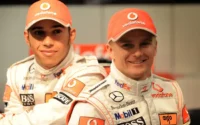
Further changes followed across the grid. On 15 November 2006, Super Aguri confirmed Anthony Davidson as the replacement for Sakon Yamamoto. On 24 November, McLaren completed their line-up by promoting GP2 Series champion Lewis Hamilton from their junior programme, marking the Formula One debut of a driver who would soon reshape the sport.
Spyker confirmed Adrian Sutil as their first driver on 21 December 2006, replacing Tiago Monteiro, who was bound for the World Touring Car Championship. Mid-season upheaval followed in 2007 when, on 10 July, Spyker announced that Christijan Albers would no longer race for the team due to a failure to pay sponsorship monies. Markus Winkelhock filled in for the European Grand Prix, before Spyker confirmed on 25 July that Sakon Yamamoto would contest the remaining seven races of the season.
Another notable mid-season change came on 31 July 2007, when Scuderia Toro Rosso replaced Scott Speed with BMW Sauber test driver Sebastian Vettel. The decision followed an alleged physical altercation between Speed and team principal Franz Tost.
The final driver change of the season occurred late in the year. On 8 October 2007, Alexander Wurz announced his immediate retirement from Formula One. Williams test driver Kazuki Nakajima stepped in to replace him for the 2007 Brazilian Grand Prix.
Other Changes
One final milestone occurred away from the spotlight. On 30 September 2006, Cosworth announced a temporary withdrawal from Formula One as an engine supplier, citing a lack of customer teams following Williams’ move to Toyota and Spyker’s switch to Ferrari. As a result, the 2007 season became the first since 1962 to feature no Cosworth-powered cars. The company later confirmed it would return to Formula One from the 2010 season onwards.
Regulation changes
Although the FIA had originally intended to introduce a single tyre supplier from the 2008 season onward, Formula One effectively entered that era a year early. Following Michelin’s withdrawal at the end of 2006, Bridgestone became the championship’s sole tyre supplier for 2007.
Revised Sporting Regulations altered tyre usage across the race weekend. Each driver was allocated a total of 14 sets of dry-weather tyres: four sets reserved exclusively for Friday practice, with the remaining ten sets available for the rest of the weekend. During the race itself, drivers were required to use both tyre compounds — hard and soft — at least once. At the opening round in Australia, the softer compound was identified by a white spot on the tyre sidewall. As this proved difficult to see at speed, the system was revised from the Malaysian Grand Prix onward, with one of the four grooves on the soft tyre painted white to improve visibility.
Further changes affected Friday running. Teams that had finished 5th to 11th in the 2006 Constructors’ Championship were no longer permitted to run a third car on Fridays, bringing them in line with the top four teams, who were already subject to this restriction.
Engine development was frozen starting from the 2006 Japanese Grand Prix, with those homologated engines mandated for use throughout both the 2007 and 2008 seasons. The FIA described this process as engine “homologation”, accelerating a cost-control measure that had initially been planned for 2008.
Several safety-related updates were also introduced. All cars were fitted with red, blue, and yellow LED cockpit lights to relay information about track signals or conditions directly to the driver. Each light had a minimum diameter of 5 mm and was positioned within the driver’s normal line of sight. In addition, every car carried an accident warning light linked to the FIA data logger. Mounted on top of the survival cell and facing upward, this light provided rescue crews with an immediate indication of accident severity.
Practice formats were expanded, with both Friday sessions extended from 60 minutes to 90 minutes. Teams were allowed to run two cars, driven either by their race drivers or a nominated third driver.
Engine penalties were also refined. Any engine change made on the first day of the race weekend carried no penalty; penalties were applied only for changes made on the second day.
Safety car procedures were tightened. Cars were no longer allowed to enter the pits for refuelling immediately after a safety car was deployed. Instead, drivers had to wait until all cars were grouped behind the safety car and the pit lane was officially declared open. Additionally, lapped cars positioned between the safety car and the race leader were required to pass the safety car and rejoin at the back of the queue before the restart.
The teams unanimously agreed to voluntarily introduce the testing restrictions originally planned for 2008. Each team was limited to 30,000 kilometres (19,000 miles) of testing per year.
To aid identification, the second car of each team was required to run a yellow roll hoop, while the first car retained the traditional red or orange roll hoop. This change was designed to help spectators distinguish between teammates at a distance.
With Scuderia Toro Rosso switching to Ferrari 056 engines, all teams were now running the mandated 2.4-litre naturally aspirated V8 engines. This marked the first time the entire grid used the same engine configuration, following a transitional year in 2006 when V10 engines were still permitted under certain conditions.
Finally, as a result of a decision taken in 2006, tobacco advertising promoting smoking products was fully banned from car liveries for the 2007 season.
Television coverage
Formula One Management took a major step toward standardising broadcast output by acting as the host broadcaster for all but three of the seventeen Grands Prix. For the first time, all coverage was produced in anamorphic 16:9 widescreen format.
Broadcasters including ITV Sport, Premiere, ORF1, RTL7, TF1, TV3, and Polsat were among the first to deliver a standard 16:9 widescreen feed at the opening race in Australia.
In the United States, Speed Channel remained the primary broadcaster, but FOX also aired four races: the Canadian, United States, French, and British Grands Prix. The Canadian and United States Grands Prix were broadcast live.
Poland saw a change in broadcaster, with Formula One coverage moving from TV4 to Polsat. In Portugal, SportTV replaced RTP1 as the championship’s broadcast partner.
Circuits
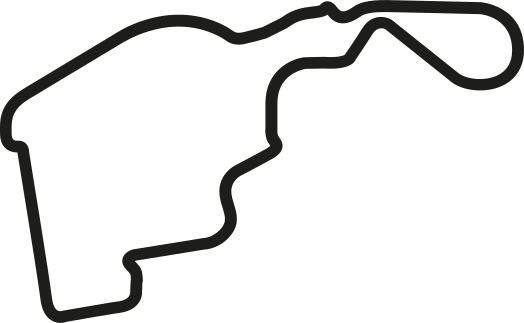
Several circuits underwent notable modifications ahead of the 2007 season. At the Circuit de Catalunya in Barcelona, a new chicane was added to the straight between the Europcar corner and the final New Holland corner. The goal was to reduce speeds before the main straight and increase overtaking opportunities into Turn 1.
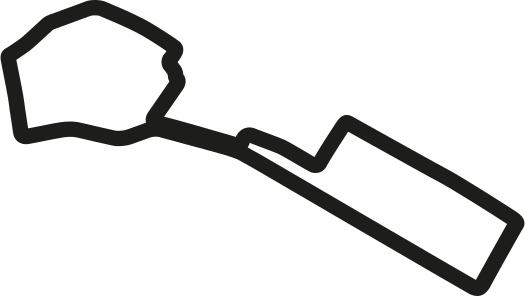
Spa-Francorchamps also received extensive updates, including a new paddock, a reprofiled Bus Stop chicane, an extension of the start–finish straight, and changes to the La Source hairpin.
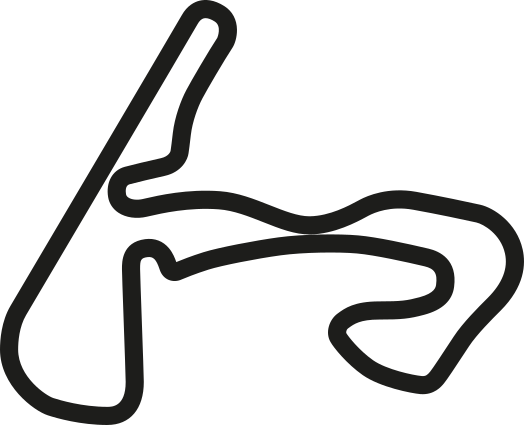
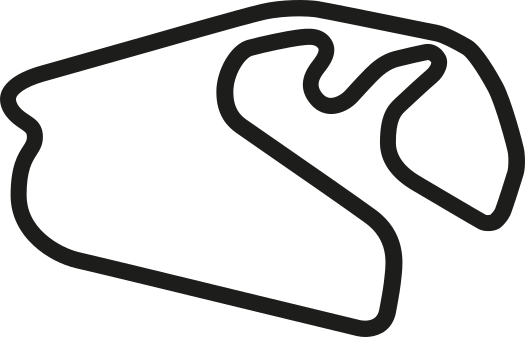
The most extensive work took place at the Autódromo José Carlos Pace in São Paulo. The circuit underwent its largest repair programme in 35 years to address long-standing issues with the track surface. All existing asphalt was removed and replaced, while the pit lane entry was redesigned to improve safety. The circuit was closed for five months, from June to October, reopening just in time for the Brazilian Grand Prix.
2007 Formula 1 Race Calendar
On 29 August 2006, the FIA released a provisional calendar for the 2007 FIA Formula One World Championship. Notably absent from this initial schedule were the San Marino Grand Prix and the European Grand Prix, although the latter would later reappear under different circumstances. The finalised calendar, published on 18 October 2006, confirmed that the San Marino Grand Prix would not return to the championship for 2007.
The season marked a rare absence for Germany on the Formula One calendar. For the first time in almost fifty years, no German Grand Prix was held. This situation arose from an agreement for the Nürburgring and Hockenheim circuits to alternate hosting duties; however, the promoter of the Hockenheim race retained the commercial rights to the “German Grand Prix” name. With no agreement reached between the two venues over naming rights, the Nürburgring event proceeded under its traditional European Grand Prix title instead.
Japan also saw a major change of venue. After two decades at the Honda-owned Suzuka Circuit, where it had been held continuously since 1987, the Japanese Grand Prix moved to Toyota’s newly rebuilt Fuji Speedway. Formula One had not raced at Fuji since 1977, making the switch both a return to history and a showcase of modern redevelopment.
The Belgian Grand Prix at Spa-Francorchamps returned to the calendar following a one-year absence in 2006, which had been caused by extensive circuit maintenance. Its reinstatement restored one of the championship’s most iconic venues to the schedule.
Finally, the 2007 season reached a subtle but notable milestone: for the first time since 1975, no country hosted more than one Grand Prix, giving the calendar a uniquely global balance.
2007 Formula 1 Race Reports
Round 1: Australian Grand Prix
Race date: 18 March
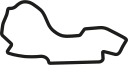
Circuit: Albert Park Circuit , Melbourne
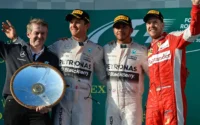
Kimi Raikkonen won the season-opening 2007 Australian Grand Prix with Ferrari, marking his tenth F1 victory. The race also featured Lewis Hamilton securing an impressive third-place finish with McLaren in his F1 debut. Hamilton’s teammate, Fernando Alonso, finished second.
Criticism was directed at Bridgestone for poorly visible tyre markings of the soft options when the car was on track, prompting a change in the next race. It was the first Grand Prix since the 2000 Malaysian Grand Prix where all Formula One teams used Bridgestone tyres, following Michelin’s departure from the sport after the 2006 season
Round 2: Malaysian Grand Prix
Race date: 8 April
Circuit: Sepang International Circuit
McLaren secured a dominant 1-2 finish at the 2007 Malaysian Grand Prix, with Fernando Alonso taking victory and teammate Lewis Hamilton finishing second.
The Ferrari of Felipe Massa started from pole but was swiftly overtaken by both McLarens within the first two corners of the opening lap. The result continued Hamilton’s sensational rookie campaign, marking his second podium in as many Formula One races. Previous race winner Kimi Raikkonen finished third for Ferrari.
Reflecting on the gruelling conditions, Hamilton admitted, “I can’t explain how tough it was, how hot in the cockpit,” Hamilton said. “I ran out of water, so halfway through the race I didn’t have enough. It was getting hotter and hotter. It was nice to have a gap, but I pushed to the end. I had to dig as deep as I could by preserving the energy I had to bring the car to the end. I am overwhelmed.”
Formula One History Recommends
Round 3: Bahrain Grand Prix
Race date: 15 April
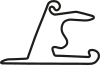
Circuit: Bahrain International Circuit, Sakhir
Mclaren driver Lewis Hamilton and his extraordinary debut season continued at the 2007 Bahrain Grand Prix, where he secured his third podium in as many races—setting a new benchmark for the best start by a rookie. Outpacing his McLaren teammate Fernando Alonso, Hamilton finished second behind the Ferrari of race winner Felipe Massa, who had just enough in hand to fend off the Briton’s late challenge. Massa’s teammate Kimi Raikkonen finished third.
“Three races in to be a contender for the world championship is phenomenal,” said McLaren chief executive Martin Whitmarsh. “We all have to conclude now that Lewis is a serious title challenger. He’ll want to go better now and win a race. I don’t think anybody doubts that he will do that this season.”
Round 4: Spanish Grand Prix
Race date: 13 May
Circuit: Circuit de Catalunya , Montmeló
Ferrari driver Felipe Massa claimed victory at the 2007 Spanish Grand Prix, finishing nearly seven seconds ahead of the McLaren duo of Lewis Hamilton and Fernando Alonso, who took second and third, respectively.
With this result, Hamilton made F1 history by leading the 2007 Drivers’ Championship after just four Formula One races—despite not yet securing a race win. At 22 years old, he became the youngest F1 driver ever to top the standings, breaking the record previously held by McLaren founder Bruce McLaren.
Round 5: Monaco Grand Prix
Race date: 27 May
Circuit: Circuit de Monaco , Monte Carlo
Lewis Hamilton remained joint leader of the Drivers’ Championship after finishing second for the fourth time in his debut season at the 2007 Monaco Grand Prix, behind his McLaren teammate and double world champion Fernando Alonso. “It’s my first season in Formula One and here I am finishing second, so I can’t complain,” Hamilton said. It marked McLaren’s 150th F1 win and their 14th at Monaco. Brazilian Felipe Massa finished third in a Ferrari.
Round 6: Canadian Grand Prix
Race date: 10 June
Circuit: Circuit Gilles Villeneuve , Montreal
Lewis Hamilton secured his first F1 win at the 2007 Canadian Grand Prix, his sixth race, after earning podium finishes in all previous five rounds. The win allowed him to extend his lead in the Drivers’ Championship by eight points over his McLaren teammate, Fernando Alonso. “I’ve been prepared for this win for quite some time, it was just a question of where and when,” Hamilton commented. He dedicated his victory to his father, saying, “Without him, this wouldn’t have been possible.” In the final laps, he focused on counting them down to victory.
Nick Heidfeld finished second for Sauber and Alexander Wurz was third for Williams. It the first Grand Prix of the 2007 season that drivers from teams other than Ferrari and McLaren reached podium positions. It was the final podium of Wurz’s career.
The race wasn’t without incident with multiple misfortunes. The safety car was deployed four times. The biggest came when Robert Kubica experienced a huge crash on the approach to the hairpin, hitting the back of Jarno Trulli‘s Toyota. He miraculously escaped serious injury when his Sauber hit the wall head-on, rolled across the track, and slid sideways along another wall. As a result of his crash, Kubica was unable to race at the next Grand Prix in the United States.
Round 7: United States Grand Prix
Race date: 17 June
Circuit: Indianapolis Motor Speedway, Speedway
Lewis Hamilton won the 2007 United States Grand Prix in Indianapolis ahead of his McLaren teammate, Fernando Alonso, who, as the season progressed, had become increasingly unsettled by Hamilton’s success. Ferrari driver Felipe Massa completed the podium by finishing third.
The two drivers battled it out in the race, with Hamilton matching Alonso’s fastest lap shortly after it was set. Alonso expressed his surprise at Hamilton’s rapid ascent to the top of the championship standings, despite previously voicing concerns over perceived preferential treatment towards Hamilton by McLaren. “It’s a surprise to see him doing so well and top of the championship.”
Post-race, a journalist likened Hamilton to Tiger Woods, to which Hamilton humbly responded by distinguishing his own identity and sport from that of Woods. “It’s obviously nice to be compared to somebody like Tiger Woods but you just have to remember I’m not Tiger Woods. I’m Lewis Hamilton and this is Formula One, it is not golf.”
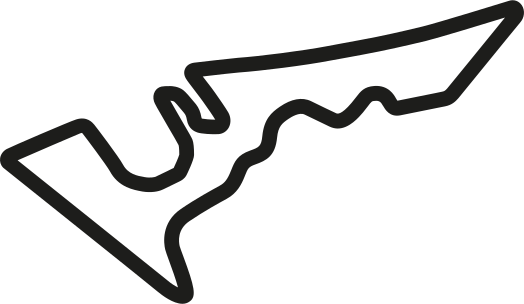
This was also the debut race of the future four-time world champion Sebastian Vettel with the BMW Sauber F1 Team. It was also the last visit to Indianapolis after an eight-season run. The event was removed from the 2008 calendar a few months later, and F1 didn’t return to the USA until November 2012 at the Circuit of the Americas.
Round 8: French Grand Prix
Race date: 1 July
Circuit: Circuit de Nevers Magny-Cours, Magny-Cours
On this day, Kimi Raikkonen dominated the 2007 French Grand Prix, thwarting a bid from Lewis Hamilton for a hat-trick of wins.
Hamilton’s strategy hinged on a three-stop plan that required a strong start. However, Raikkonen overtook him at the beginning and set his sights on catching Felipe Massa in the leading Ferrari. The race then became a duel between the two Ferrari drivers, with Raikkonen gaining the upper hand when Massa encountered traffic during his second stint.
Massa, who started the race from pole, finished second, with Lewis Hamilton third in the McLaren.
Round 9: British Grand Prix
Race date: 8 July
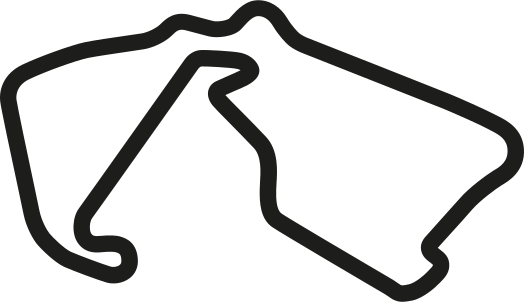
Circuit: Silverstone Circuit , Silverstone
Lewis Hamilton‘s hopes of winning his first home race at the 2007 British Grand Prix were dashed by a botched pit stop, dropping him to third behind Kimi Raikkonen and Fernando Alonso. Hamilton led Raikkonen at the start but couldn’t maintain a sufficient gap on a lighter fuel load. During his second pit stop, he mistakenly lifted the clutch with the fuel hose still attached, costing him valuable time. Despite this, Hamilton left the race still leading the championship, but the error proved costly at the season’s end when he lost the title by a single point.
Round 10: European Grand Prix
Race date: 22 July
Circuit: Nürburgring, Nürburg
Fernando Alonso won the 2007 European Grand Prix at the Nürburgring, narrowing the championship gap to just two points between himself and McLaren teammate Lewis Hamilton. A rainstorm hit the circuit after just one lap, resulting in the extraordinary sight of debutant Markus Winkelhock leading his first F1 race by half a minute in a Spyker. Unfortunately for Winkelhock, the conditions were so severe that the race had to be suspended.
On the restart, Kimi Raikkonen led Felipe Massa and Alonso, but further rainfall and more pit stops shuffled the order, allowing Alonso to win ahead of Massa and Mark Webber in a Red Bull. BBC radio listeners enjoyed the commentary of Murray Walker for the first time since his retirement in 2001.
Round 11: Hungarian Grand Prix
Race date: 5 August
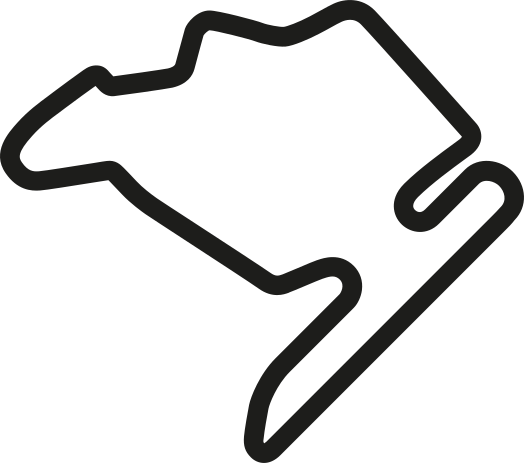
Circuit: Hungaroring , Mogyoród
Lewis Hamilton secured his third win and 10th podium finish of his debut season at the 2007 Hungarian Grand Prix. Kimi Raikkonen for Ferrari took second, while Nick Heidfeld in the BMW Sauber completed the top three.
The qualifying session on Saturday was caught up in controversy when Alonso deliberately delayed in the pit box, preventing Hamilton from changing his tyres and completing his final flying lap in Q3. This denied Hamilton the chance to take pole position. However, Alonso received a five-place grid penalty, handing pole to the Englishman. Alonso would finish the race in fourth.
Ralf Schumacher scored his last World Championship points at this race, finishing sixth for Toyota.
Round 12: Turkish Grand Prix
Race date: 26 August
Circuit: Istanbul Park, Istanbul
Felipe Massa won the 2007 Turkish Grand Prix on 26 August at Istanbul Park, marking the third time a Formula 1 race was held at this circuit. The previous winners were Kimi Raikkonen in 2005 and Massa in 2006, both of whom were competing for Ferrari in the 2007 season. Raikkonen took second place while McLaren driver Fernando Alonso took third. In the post-race press drivers’ conference, Massa commented that “Istanbul Park was the track where he made his career turn-around and finally began winning races.”
Round 13: Italian Grand Prix
Race date: 9 September
Circuit: Autodromo Nazionale di Monza , Monza
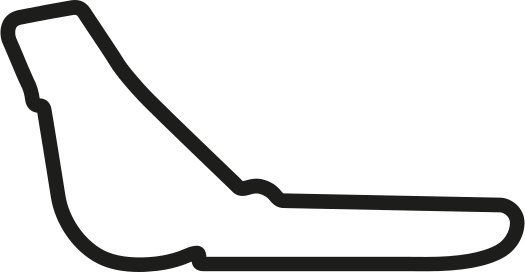
Fernando Alonso led a McLaren 1-2 finish at the 2007 Italian Grand Prix, ahead of teammate Lewis Hamilton. This result significantly reduced Hamilton’s championship lead to just three points, while the Ferrari of third-placed Kimi Raikkonen remained a distant contender, 18 points behind with 40 still up for grabs. The final races of the season would prove to be full of unexpected twists.
This victory marked McLaren’s eighth win at Monza, while Alonso became the first Spanish driver to win the Italian Grand Prix. It would be his last win for McLaren. It was also McLaren’s final 1-2 finish until the Chinese Grand Prix in 2010.
Formula One History Recommends
Round 14: Belgian Grand Prix
Race date: 16 September
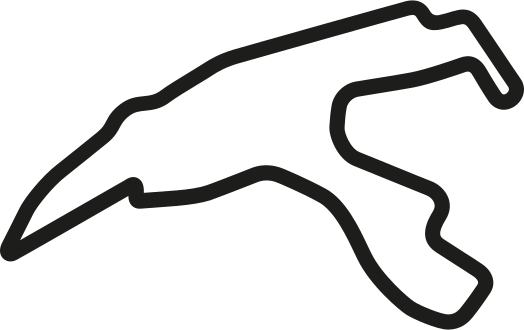
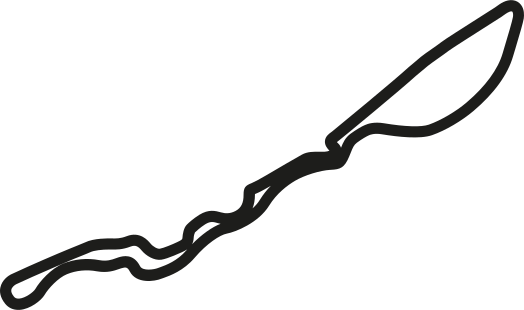
Circuit: Circuit de Spa-Francorchamps, Stavelot
The 2007 Belgian Grand Prix was a milestone for Fernando Alonso and Mark Webber, as they each started their 100th Grand Prix. Alonso finished on the podium in third place for McLaren, while Webber achieved his second-best result of the season by finishing seventh with Red Bull Racing. Ferrari drivers Kimi Raikkonen and Felipe Massa finished in first and second, respectively, clinching the 2007 World Constructors Championship for the team.
The race was overshadowed by the death of former World Rally Champion Colin McRae in a helicopter crash during Saturday’s qualifying.
Round 15: Japanese Grand Prix
Race date: 30 September
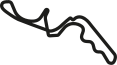
Circuit: Fuji Speedway, Oyama, Shizuoka
McLaren driver Lewis Hamilton demonstrated his wet-weather prowess with a stunning victory at the 2007 Japanese Grand Prix, where he’d also taken pole and the fastest lap of the race, while his teammate Fernando Alonso spun off after 42 laps. Hamilton later revealed that the team told him to slow down in the final laps, but he was already driving as cautiously as he could. Ferrari boss Luca di Montezemolo was not pleased, accusing McLaren of benefiting from Ferrari’s technology due to the Spygate scandal. However, Hamilton’s campaign faltered in the final races, allowing Ferrari’s Kimi Raikkonen to win the last two Grands Prix and claim the 2007 Drivers’ Championship. The Renault of Heikki Kovalainen claimed second, the teams’ only podium of the season, while Raikkonen took third.
Round 16: Chinese Grand Prix
Race date: 7 October
Circuit: Shanghai International Circuit, Shanghai
At the 2007 Chinese Grand Prix, Lewis Hamilton was expected to put the Drivers’ title almost out of reach in his debut season … but it wasn’t to be. He started on pole on intermediate tyres, but as the track dried, McLaren elected to keep him out and stick to the original pit strategy, allowing the Ferrari of Kimi Raikkonen to take the lead. As Hamilton headed into the pits with his tyres completely worn, he failed to negotiate a sharp left-hand turn and his car slid into the gravel, ending his race. “You cannot go through life without making mistakes,” he shrugged. “The tyres were finished, it was like driving on ice.” Raikkonen went on to win the race and set up the finale in Brazil where he clinched the championship. Hamilton’s teammate Fernando Alonso finished the race second, and Felipe Massa in the other Ferrari finished third.
Round 17: Brazilian Grand Prix
Race date: 21 October
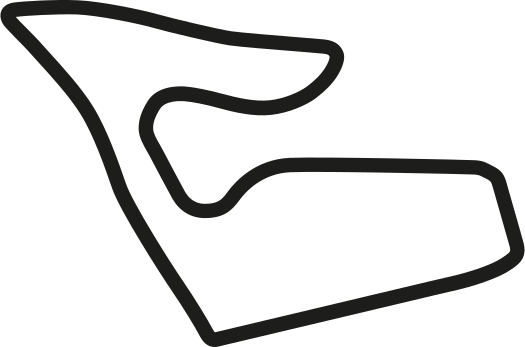
Circuit: Autódromo José Carlos Pace , São Paulo
Ferrari driver Kimi Raikkonen clinched his first and only Drivers’ Championship at Interlagos by a single point, beating both the McLarens of Lewis Hamilton and Fernando Alonso in a dramatic season finale. F1 rookie, Hamilton entered the 2007 Brazilian Grand Prix leading the championship, with the title within his grasp. However, a poor start saw him fall to fourth, with the Ferraris and his teammate Alonso getting ahead. In an attempt to overtake Alonso around the outside, Hamilton ran off the track and rejoined in eighth. Things worsened when his McLaren briefly lost power, dropping him to 18th. Though Hamilton fought back to finish seventh, it wasn’t enough, as Raikkonen won the race and the title. “This is my first year, I’ll come back stronger. I’ve learned a lot, and the mistakes I made won’t happen again next year,” Hamilton vowed. True to his word, he returned in 2008 to claim the championship in even more dramatic fashion. Raikkonen’s teammate, Felipe Massa, finished second for a Ferrari 1-2 finish, with Alonso in third.
The race also saw the last time cars with traction control were allowed and the final race for Ralf Schumacher who finished in 11th place for Toyota.
Formula One History Recommends
2007 Formula 1 Race Results
Grands Prix
3 McLaren was not allowed to have a team representative on the podium other than a driver.
2007 Formula 1 Standings
Driver standings
| Pos | Driver | Nationality | Car | PTS |
|---|---|---|---|---|
| 1 | Kimi Räikkönen | FIN | Ferrari | 110 |
| 2 | Lewis Hamilton | GBR | McLaren Mercedes | 109 |
| 3 | Fernando Alonso | ESP | McLaren Mercedes | 109 |
| 4 | Felipe Massa | BRA | Ferrari | 94 |
| 5 | Nick Heidfeld | GER | Sauber BMW | 61 |
| 6 | Robert Kubica | POL | Sauber BMW | 39 |
| 7 | Heikki Kovalainen | FIN | Renault | 30 |
| 8 | Giancarlo Fisichella | ITA | Renault | 21 |
| 9 | Nico Rosberg | GER | Williams Toyota | 20 |
| 10 | David Coulthard | GBR | Red Bull Renault | 14 |
| 11 | Alexander Wurz | AUT | Williams Toyota | 13 |
| 12 | Mark Webber | AUS | Red Bull Renault | 10 |
| 13 | Jarno Trulli | ITA | Toyota | 8 |
| 14 | Sebastian Vettel | GER | STR Ferrari | 6 |
| 15 | Jenson Button | GBR | Honda | 6 |
| 16 | Ralf Schumacher | GER | Toyota | 5 |
| 17 | Takuma Sato | JPN | Super Aguri Honda | 4 |
| 18 | Vitantonio Liuzzi | ITA | STR Ferrari | 3 |
| 19 | Adrian Sutil | GER | Spyker Ferrari | 1 |
| 20 | Rubens Barrichello | BRA | Honda | 0 |
| 21 | Scott Speed | USA | STR Ferrari | 0 |
| 22 | Kazuki Nakajima | JPN | Williams Toyota | 0 |
| 23 | Anthony Davidson | GBR | Super Aguri Honda | 0 |
| 24 | Sakon Yamamoto | JPN | Spyker Ferrari | 0 |
| 25 | Christijan Albers | NED | Spyker Ferrari | 0 |
Team standings
| Pos | Team | PTS |
|---|---|---|
| 1 | Ferrari | 204 |
| 2 | Sauber BMW | 101 |
| 3 | Renault | 51 |
| 4 | Williams Toyota | 33 |
| 5 | Red Bull Renault | 24 |
| 6 | Toyota | 13 |
| 7 | STR Ferrari | 8 |
| 8 | Honda | 6 |
| 9 | Super Aguri Honda | 4 |
| 10 | Spyker Ferrari | 1 |
| EX | McLaren Mercedes | 0 |