

































The lights went out on a new era of Formula 1 at the 2026 Australian Grand Prix, and for once, the hype was justified. The opening round of the 2026 F1 World Championship arrived not just as another season curtain-raiser, but as the launch point for sweeping technical regulation changes that promised to redraw the competitive order. New power unit architecture, revised aerodynamics, and a reset in car philosophy meant that Melbourne wouldn’t simply reveal who was quickest; it would offer the first real clues about who had interpreted Formula 1’s future most intelligently.
Few venues carry the weight of tradition quite like the Australian Grand Prix. First staged on the streets of Adelaide in 1985 before relocating to Melbourne’s Albert Park in 1996, the race has spent almost four decades shaping the tone of entire seasons, sparking title fights, delivering shock debut wins and producing chaotic, red-flag-strewn dramas that still echo through the sport’s lore. On March 8, Melbourne hosts its 40th Australian Grand Prix, once again opening the championship and now ushering in a fresh chapter of F1.
Race Guide
Season: 2026 F1 World Championship
Race weekend: 6 March 2026 – 8 March 2026
Race date: Sunday, 8 March 2026
Race start time: 15:00 local time
Circuit: Albert Park
Laps: 58
Circuit length: 5.278km
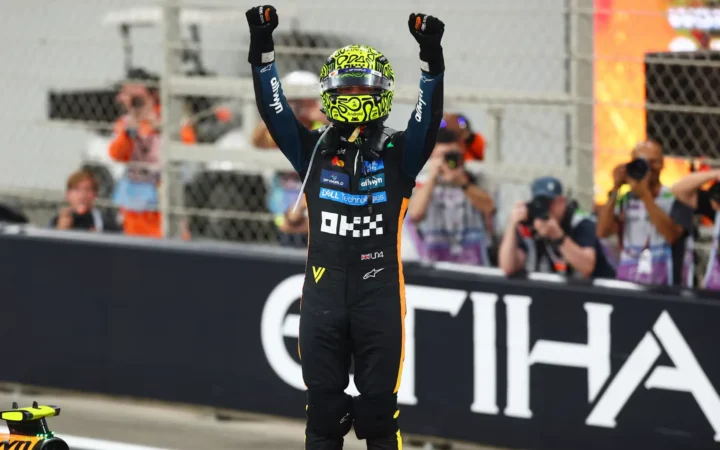
2025 winner: Lando Norris
| Pole position | |||
|---|---|---|---|
| Driver | TBC | TBC | |
| Time | TBC | ||
| Fastest lap | |||
| Driver | TBC | TBC | |
| Time | TBC | ||
| Podium | |||
| First | TBC | TBC | |
| Second | TBC | TBC | |
| Third | TBC | TBC | |
Since joining the calendar in 1996, Melbourne’s Albert Park Grand Prix Circuit has become Formula 1’s ultimate tone-setter, a semi-permanent street track that rewards confidence, punishes complacency and rarely delivers a predictable script. At 5.278km, with 14 corners blending high-speed sweeps and heavy-braking zones, it’s a circuit that has evolved in recent seasons to encourage closer racing, yet still retains the unforgiving walls that give an opening round its edge. Pole position matters here, but so does racecraft: Safety Cars are common, red flags are no longer a rarity, and strategy calls under pressure have defined more than one championship narrative before it’s properly begun.
Albert Park Circuit Stats
Albert Park’s history reads like a highlight reel of Formula 1’s modern eras. The inaugural Melbourne race in 1996 saw Martin Brundle famously sprint back to the pits after a first-lap flip, while Damon Hill claimed victory. In 2002, a dramatic Turn 1 pile-up launched Ralf Schumacher’s Williams over Rubens Barrichello’s Ferrari before Michael Schumacher prevailed. 2009 delivered one of the sport’s great fairytales as Brawn GP stunned the paddock with a debut 1-2 finish, setting up a championship run few saw coming.
See also…
From Fernando Alonso’s airborne escape in 2016 to Sebastian Vettel’s strategic masterclass over Lewis Hamilton in 2017, and the triple red-flag chaos of 2023 won by Max Verstappen, Melbourne has consistently amplified the moment. Even 2025 proved the rule: Lando Norris mastered mixed conditions to win from pole in a rain-hit 2025 opener.
Weekend Schedule
| Date | Session | Local Time |
|---|---|---|
| 6 March 2026 | Free Practice 1 (FP1) | 12:30 pm – 1:30 pm local time |
| 6 March 2026 | Free Practice 2 (FP2) | 4:00 pm – 5:00 pm local time |
| 7 March 2026 | Free Practice 3 (FP3) | 12:30 pm – 1:30 pm local time |
| 7 March 2026 | Qualifying | 4:00 pm – 5:00 pm local time |
| 8 March 2026 | Race | 3:00 pm local time |
Saturday qualifying summary to come…
Sunday race summary to come…
Championship background
The early signals from pre-season testing were clear: this was no one-team era. The reset ushered in by Formula 1’s sweeping 2026 regulation changes appeared to have compressed the field rather than stretched it, with lap times in Bahrain hinting at a genuine four-team contest at the front. Mercedes and Ferrari emerged from testing with the strongest long-run consistency, and if Melbourne mirrored those trends, the first chapter of the 2026 F1 World Championship could be decided between silver and red.
That put George Russell and rookie sensation Kimi Antonelli firmly in the frame for Mercedes, while Ferrari’s formidable pairing of Charles Leclerc and Lewis Hamilton arrived with quiet confidence, especially if their eye-catching single-lap pace from testing translated into Albert Park’s crucial qualifying hour. But writing off the reigning powers would have been premature. Lando Norris began the season as defending world champion after his breakthrough 2025 campaign, with McLaren expected to be firmly in contention. Red Bull, meanwhile, rarely started slowly, and four-time world champion Max Verstappen remained the benchmark driver. Add in home favourite Oscar Piastri to the mix, and Melbourne looked to deliver one of the most competitive season openers in years.
Race entries
Of the 2025 teams, only two had driver changes. Red Bull Racing changed one driver, with Isack Hadjar stepping up from Racing Bulls to replace Yuki Tsunoda for 2026. Red Bull Racing Junior and British driver Arvid Lindblad filled the vacant seat, left by Hadjar, at Racing Bulls. The only rookie driver on the grid.
With Cadillac joining the grid for 2026, Sergio Pérez and Valtteri Bottas returned to F1 to spearhead the team’s debut season.
Tyre choices
The technical reset for 2026 didn’t stop at the chassis and power units. Pirelli’s tyres had evolved too. While the 18-inch wheel rim remained, the tyres now featured a reduced overall diameter and a smaller contact patch, subtly reshaping the cars’ mechanical balance. There were still five slick compounds ranging from C1 (hardest) to C5 (softest), supported by the green-banded Intermediate and blue-marked Full Wet for variable conditions. For Albert Park, Pirelli opted for the three softest compounds in the range — C3, C4 and C5 — mirroring the selection from the previous two seasons and opening the door to aggressive strategy calls if degradation remained manageable.
Melbourne’s 5.278km semi-street layout, wrapped around Albert Park Lake, traditionally places modest stress on tyres compared to permanent circuits. The surface — made up partly of public roads — is smooth, and degradation tends to be governed more by surface wear than thermal overload. Graining had appeared in recent years, though typically at low levels, and the reduced contact patch in 2026 could alter how quickly that phenomenon developed across a stint.
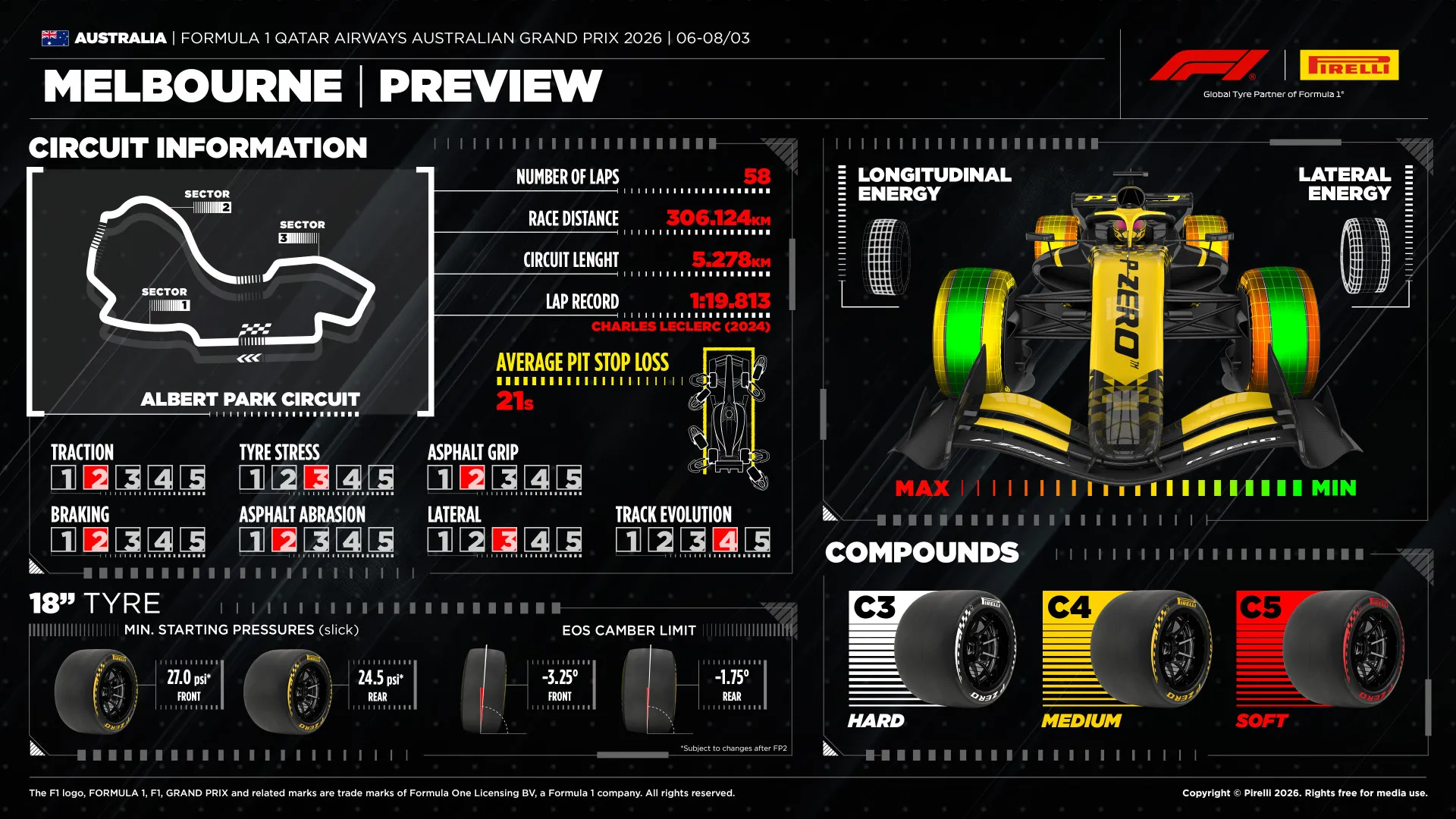
From the first laps of Friday practice, teams would be studying how best to manage temperature distribution across both axles — particularly given the increased energy delivery to the rear axle under the new power unit regulations, which could create balance asymmetries. Adjusting tyre blanket preparation or adding a build-up lap before a qualifying run could prove decisive.
Strategically, Melbourne remained a circuit where track position is king. Overtaking exists, but in the past, it was far from straightforward, even with the smaller 2026 cars and the introduction of the new Overtake mode. That raised the question of pit stop numbers: would teams risk running the softest C5 in race conditions on what was, in theory, a low-severity track? The answer would depend on individual car-load characteristics and real-world degradation data gathered over the weekend. And then there’s the weather — early autumn in Melbourne is notoriously unpredictable. The 2025 race was shaped by intermittent rain, with Lando Norris mastering conditions on Intermediates. Another swing in temperature or a passing shower could once again turn tyre strategy from a calculated science into a split-second gamble.
FIND OUT MORE
Free Practice
FP1 summary to come…
FP2 summary to come…
FP3 summary to come…
Free Practice 1 Classification
FP1 of the 2026 Australian Grand Prix was held on 6 March 2026 from 12:30 pm to 1:30 pm local time.
Free Practice 2 Classification
FP2 of the 2026 Australian Grand Prix was held on 6 March 2026 from 4:00 pm to 5:00 pm local time.
Free Practice 3 Classification
FP2 of the 2026 Australian Grand Prix was held on 7 March 2026 from 12:30 pm to 1:30 pm local time.
Qualifying
Qualifying summary to come…
Qualifying Classification
Qualifying for the 2026 Australian Grand Prix was held on 7 March 2026 from 4:00 pm to 5:00 pm local time.
2026 Australian Grand Prix Starting Grid
The Grand Prix starting grid, with or without penalties, after the 2026 Australian Grand Prix Qualifying session.
What happened in the 2026 Australian Grand Prix?
Race report to come…
2026 Australian Grand Prix race results
The 2026 Australian Grand Prix was held on 8 March 2026 at 3:00 pm local time.
2026 Australian Grand Prix Fastest Laps
2025 Post-Race F1 Championship Standings
Championship standings for Drivers’ and Teams after the 2026 Australian Grand Prix.
2026 Post-Race F1 Drivers’ Championship Standings
| POS | Driver | Nationality | Car | PTS |
|---|---|---|---|---|
| 1 | Pierre Gasly | FRA | Alpine-Mercedes | 0 |
| 2 | Franco Colapinto | ARG | Alpine-Mercedes | 0 |
| 3 | Fernando Alonso | ESP | Aston Martin Aramco-Honda | 0 |
| 4 | Lance Stroll | CAN | Aston Martin Aramco-Honda | 0 |
| 5 | Gabriel Bortoleto | BRA | Audi | 0 |
| 6 | Nico Hülkenberg | GER | Audi | 0 |
| 7 | Sergio Perez | MEX | Cadillac-Ferrari | 0 |
| 8 | Valtteri Bottas | FIN | Cadillac-Ferrari | 0 |
| 9 | Charles Leclerc | MON | Ferrari | 0 |
| 10 | Lewis Hamilton | GBR | Ferrari | 0 |
| 11 | Esteban Ocon | FRA | Haas-Ferrari | 0 |
| 12 | Oliver Bearman | GBR | Haas-Ferrari | 0 |
| 13 | Lando Norris | GBR | McLaren-Mercedes | 0 |
| 14 | Oscar Piastri | AUS | McLaren-Mercedes | 0 |
| 15 | Kimi Antonelli | ITA | Mercedes | 0 |
| 16 | George Russell | GBR | Mercedes | 0 |
| 17 | Liam Lawson | NZL | Racing Bulls-Red Bull Ford | 0 |
| 18 | Arvid Lindblad | GBR | Racing Bulls-Red Bull Ford | 0 |
| 19 | Max Verstappen | NED | Red Bull Racing-Red Bull Ford | 0 |
| 20 | Isack Hadjar | FRA | Red Bull Racing-Red Bull Ford | 0 |
| 21 | Alexander Albon | THA | Williams-Mercedes | 0 |
| 22 | Carlos Sainz | ESP | Williams-Mercedes | 0 |
2026 Post-Race F1 Constructors’ Championship Standings
| POS | Car | PTS |
|---|---|---|
| 1 | Alpine-Mercedes | 0 |
| 2 | Aston Martin Aramco-Honda | 0 |
| 3 | Audi | 0 |
| 4 | Cadillac-Ferrari | 0 |
| 5 | Ferrari | 0 |
| 6 | Haas-Ferrari | 0 |
| 7 | McLaren-Mercedes | 0 |
| 8 | Mercedes | 0 |
| 9 | Racing Bulls-Red Bull Ford | 0 |
| 10 | Red Bull Racing-Red Bull Ford | 0 |
| 11 | Williams-Mercedes | 0 |
Seen in: