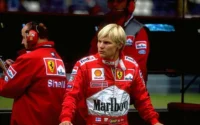





















The 2006 FIA Formula One World Championship marked a significant milestone for the sport, as it was the 60th season of Formula One motor racing and the 57th officially recognised World Championship. Running from 12 March to 22 October, the campaign was fought over 18 races and delivered one of the most memorable title fights in modern F1 history. Fernando Alonso claimed the Drivers’ Championship for the second consecutive year with Renault, becoming — at the time — the youngest double world champion the sport had ever seen. Hot on his heels was Michael Schumacher, the seven-time world champion competing in what would become his final season with Ferrari, finishing second just 13 points adrift. Renault also emerged on top in the Constructors’ Championship, narrowly beating Ferrari by five points.
Season
At the heart of the season was the intense and era-defining rivalry between Alonso and Schumacher. The two protagonists were closely matched, each taking seven wins over the course of the year. Between them, Renault and Ferrari exerted near-total control over the championship, winning all but one race. That solitary exception came at the 2006 Hungarian Grand Prix, where Jenson Button secured a landmark victory for Honda. Even podium finishes outside the two dominant teams were rare: the only four second-place results not claimed by Renault or Ferrari drivers were taken by McLaren.
Technically, 2006 was a watershed year. It saw the introduction of 2.4-litre V8 engines, replacing the screaming 3.0-litre V10s that had defined Formula One for more than a decade. The new engine formula would remain in place through to the end of the 2013 season. Uniquely, this was also the first season since 1988 — and only the second since 1997 — to feature multiple engine displacements and configurations, as Toro Rosso received special dispensation to continue using V10 engines.
The record books also noted a couple of unusual statistics. For the first time since 1956, no British constructor won a Grand Prix, and for the first time since 1957, every race was won by a car powered by an engine produced by the same manufacturer that built the chassis — a rare moment of total technical alignment in the sport.
Off the track, the driver market was already shifting before the season even began. In December 2005, Alonso confirmed his move to McLaren for 2007, setting the stage for major changes. In September 2006, Schumacher announced his retirement from Formula One at the end of the season, bringing an end to one of the most successful careers the sport has ever seen. Ferrari confirmed Kimi Räikkönen — runner-up in the 2003 and 2005 championships — as Schumacher’s replacement. Other notable departures included Juan Pablo Montoya, who left McLaren mid-season to pursue a NASCAR career, and 1997 World Champion Jacques Villeneuve, who exited the sport after the 2006 German Grand Prix. The season also introduced a future champion to the grid, with Nico Rosberg making his Formula One debut.
With the benefit of hindsight, 2006 stands as a true turning point. As of 2025, it remains Renault’s most recent Constructors’ Championship and the last Drivers’ Championship won by a Spanish driver. It also marked the end of the long-running Bridgestone–Michelin tyre war, which had begun in 2001. Michelin withdrew from Formula One at the conclusion of the season, leaving Bridgestone as the sole tyre supplier from 2007 until their own exit at the end of 2010, after which Pirelli took over from 2011.
2006 F1 Entries Drivers and Teams
Entrants in the 2006 FIA Formula One World Championship.
| Constructor | Driver No. | Driver | Rounds |
|---|---|---|---|
| Renault | 1 | Fernando Alonso | All |
| 2 | Giancarlo Fisichella | All | |
| McLaren-Mercedes | 3 | Kimi Raikkonen | All |
| 4 | Juan Pablo Montoya | 1–10 | |
| 4 | Pedro de la Rosa | 11–18 | |
| Ferrari | 5 | Michael Schumacher | All |
| 6 | Felipe Massa | All | |
| Toyota Racing | 7 | Ralf Schumacher | All |
| 8 | Jarno Trulli | All | |
| Williams-Cosworth | 9 | Mark Webber | All |
| 10 | Nico Rosberg | All | |
| Honda | 11 | Rubens Barrichello | All |
| 12 | Jenson Button | All | |
| Red Bull-Ferrari | 14 | David Coulthard | All |
| 15 | Christian Klien | 1–15 | |
| 15 | Robert Doornbos | 16–18 | |
| BMW-Sauber | 16 | Nick Heidfeld | All |
| 17 | Jacques Villeneuve | 1–12 | |
| 17 | Robert Kubica | 13–18 | |
| 18 | Tiago Monteiro | All | |
| Midland–Spyker | 19 | Christijan Albers | All |
| 20 | Vitantonio Liuzzi | All | |
| 21 | Scott Speed | All | |
| Super Aguri F1 | 22 | Takuma Sato | All |
| 23 | Yuji Ide | 1–4 | |
| 23 | Franck Montagny | 5–11 | |
| 23 | Sakon Yamamoto | 12–18 |
Friday Drivers
Seven constructors entered only drivers for free practice over the course of the season.
- Williams-Cosworth: Alexander Wurz (Austria) — All rounds
- Honda: Anthony Davidson (United Kingdom) — All rounds
- Red Bull-Ferrari: Robert Doornbos (Netherlands) — Rounds 1–15 and Michael Ammermüller (Germany) — Rounds 16–18
- BMW Sauber: Robert Kubica (Poland) — Rounds 1–12 and Sebastian Vettel (Germany) — Rounds 14–18
- MF1-Toyota: Markus Winkelhock (Germany) — Rounds 1, 3, 12–13, Giorgio Mondini (Switzerland) — Rounds 2, 4, 6–10, 14–15, Adrian Sutil (Germany) — Rounds 5, 11, 17, Alexandre Prémat (France) — Round 16, Ernesto Viso (Venezuela) — Round 18
- Toro Rosso-Cosworth: Neel Jani (Switzerland) — All rounds
- Super Aguri-Honda: Sakon Yamamoto (Japan) — Rounds 8–11 and Franck Montagny (France) — Rounds 14–18
Team Changes
The 2006 season ushered in a period of major upheaval on the team and manufacturer front, with several familiar names disappearing from the entry list — at least in name — and new players stepping into the Formula One spotlight. Minardi, BAR and Jordan all vanished as branded entities following ownership changes, while Sauber underwent a significant transition of its own. Adding further intrigue, a brand-new team, Super Aguri, joined the grid at the eleventh hour.
Minardi’s long-standing underdog story came to an end when Red Bull purchased the team. It re-emerged as Scuderia Toro Rosso — Italian for “Red Bull” — celebrating the start of Red Bull’s two-team strategy in Formula One. Sauber, meanwhile, retained its historic name largely for continuity and sentiment, despite BMW acquiring an 80% controlling stake in the operation. Founder Peter Sauber remained involved, holding the remaining 20%, but the team was effectively transformed into BMW’s factory-backed entry.
Jordan Grand Prix also underwent a full rebrand. One year after being acquired by Canadian businessman Alex Shnaider, and following a difficult final season under the Jordan name, the team was renamed MF1 Racing, reflecting Shnaider’s Midland Group. That would not be the end of the story, however: later in the season, the team was sold once again, this time to Dutch manufacturer Spyker.
Honda completed its gradual takeover of BAR during the off-season. Already owning 45% of the team, Honda acquired full control and rebranded it as the Honda Racing F1 Team at the start of the year, formally establishing itself as a full works constructor. Honda’s influence expanded further with the late arrival of Super Aguri F1, which finally secured entry after initial difficulties. The team received limited but crucial support from Honda, including engines and technical assistance, largely due to Super Aguri running Honda factory driver Takuma Sato despite being classified as a customer team. Honda’s dual supply arrangement meant that 2006 marked the first season since 2002 in which Honda provided engines to more than one team, having previously supplied both BAR and Jordan.
Elsewhere, Williams underwent substantial changes following the end of its long and successful partnership with BMW. In 2006, the Grove-based team switched to Cosworth V8 engines, a move both technical and strategic. Red Bull Racing also changed engine suppliers, adopting Ferrari power units in place of Cosworth engines — a move that followed a seventh-place finish in the Constructors’ Championship in 2005.
Tyre partnerships also shifted as Michelin sought to reduce the number of teams it supplied. As a result, both Williams and Toyota switched to Bridgestone for the season. In an interesting counterpoint, Toro Rosso moved in the opposite direction: having run Bridgestone tyres under the Minardi name, the team switched to Michelin to align more closely with its parent outfit, Red Bull Racing.
On the engine manufacturing side, 2006 saw a structural change for Mercedes. After Ilmor fully sold its UK engine division to DaimlerChrysler, Ilmor-Mercedes was officially renamed Mercedes-Benz High Performance Engines. From that point onward, Mercedes-Benz became a fully in-house engine manufacturer, responsible for the design, assembly and tuning of its Formula One power units — a defining step in its modern works-engine programme.
Driver Changes
The 2006 season brought a significant reshuffle of driver line-ups across the grid, blending established names, returning faces and emerging talent — including several drivers who would go on to shape Formula One’s future.
Ferrari made one of the most high-profile changes, ending Rubens Barrichello’s long partnership with Michael Schumacher. In his place came fellow Brazilian Felipe Massa, promoted from Sauber. Massa was no stranger to Maranello, having previously served as a Ferrari test driver in 2003, and his return marked a homecoming to the Scuderia. His departure from Sauber opened the door for Nick Heidfeld at the newly formed BMW Sauber team, who returned after driving for BMW’s former partner Williams for much of 2005 and had previously raced for Sauber between 2001 and 2003. Completing BMW Sauber’s driver line-up, Poland’s Robert Kubica was appointed as the team’s third driver, beginning his Formula One journey.
Barrichello quickly secured a new home at Honda, replacing Takuma Sato, who departed the works team. Sato instead became a central figure in Honda’s newly backed customer outfit, Super Aguri, which began its debut season with an all-Japanese race line-up of Sato and Yuji Ide. Former Renault test driver Franck Montagny joined Super Aguri as third driver, while his vacancy at Renault was filled by GP2 championship runner-up Heikki Kovalainen, another highly rated prospect entering the F1 fold.
Williams also turned to youth, promoting test driver Nico Rosberg to a full-time race seat alongside Mark Webber. Rosberg arrived as the reigning GP2 champion, having won the inaugural title in emphatic style. To support the team’s expanded driver programme, Williams recruited Alexander Wurz — previously a McLaren test driver in 2005 — as a third driver, alongside India’s Narain Karthikeyan, who continued in a reserve role after racing for Jordan the previous season. At McLaren, Gary Paffett was promoted to a permanent testing position, working alongside experienced reserve Pedro de la Rosa.
At MF1 Racing — the former Jordan team — Karthikeyan’s race seat was filled by Christijan Albers, who stepped up from Minardi after the team’s transformation. MF1 also adopted an unusual approach to its reserve driver programme, opting for a rotation system for the third driver role. Albers’ former Minardi teammate, Robert Doornbos, moved into a test-driving role at Red Bull Racing.
Red Bull’s driver structure continued to evolve following its acquisition of Minardi. Vitantonio Liuzzi, who had shared Red Bull Racing’s second race seat with Christian Klien in 2005, was reassigned to the newly renamed Toro Rosso team. There, he partnered fellow Red Bull-backed driver Scott Speed in the team’s first season under its new identity. Swiss driver Neel Jani completed the line-up as Toro Rosso’s third driver, rounding out a grid that, in 2006, balanced experience, experimentation and the emergence of a new generation of Formula One talent.
Mid-Season Changes
As the 2006 season unfolded, several teams were forced into reactive decisions and strategic reshuffles, leading to a busy and often dramatic mid-season period for driver line-ups.
Super Aguri were the first to make a significant change. Following the 2006 San Marino Grand Prix, Yuji Ide had his FIA superlicence revoked, rendering him ineligible to continue racing in Formula One. The team immediately promoted reserve driver Franck Montagny to replace Ide at the following round. From the British Grand Prix onwards, however, Super Aguri altered its structure again, hiring Sakon Yamamoto — a former Jordan test driver from 2005 — as third driver, with Montagny stepping aside. From the German Grand Prix onward, the two drivers effectively swapped roles, with Yamamoto moving into the race seat and Montagny returning to reserve duties.
A major headline followed the 2006 United States Grand Prix when Juan Pablo Montoya announced his intention to leave Formula One at the end of the season in order to pursue a NASCAR career in 2007. His departure from McLaren was brought forward almost immediately: the very next day, the team confirmed that Montoya would be replaced in the race line-up by test driver Pedro de la Rosa. The move brought Montoya’s Formula One career — which had begun in 2001 — to an abrupt end after five and a half seasons in the sport.
BMW Sauber also made a pivotal change mid-season. At the Hungarian Grand Prix, the team promoted Robert Kubica to a race seat, replacing 1997 World Champion Jacques Villeneuve. The decision was widely linked to Villeneuve’s injuries following a heavy crash at the German Grand Prix. One day after the Hungarian race, on 7 August 2006, BMW Sauber confirmed that Villeneuve had left the team with immediate effect, and that Kubica would retain the seat for the remainder of the season. Kubica’s promotion created an opening in the team’s reserve programme, which was filled from the 2006 Turkish Grand Prix onwards by German Formula 3 driver Sebastian Vettel, marking his first official involvement in a Formula One race weekend.
Red Bull Racing made one of the more ruthless calls of the season. On 11 September 2006, the team announced that Christian Klien had been officially released following a prolonged run of poor results. Red Bull turned to its third and test driver, Robert Doornbos, who was drafted in to contest the final three races of the season. For the Chinese and Japanese Grands Prix, Doornbos was temporarily replaced in third-driver duties by Michael Ammermüller.
At Spyker MF1, attention turned toward evaluating future talent. The team announced a pair of new third drivers for two of the final races of the year: GP2 Series drivers Alexandre Prémat and Ernesto Viso took part in Friday practice at the Chinese and Brazilian Grands Prix, respectively. Adrian Sutil, who had already tested for the team earlier in the season in Germany and France, returned to conduct further testing duties at the Japanese Grand Prix.
Beyond race weekends, September’s test session at Silverstone provided another glimpse of the sport’s next generation. GP2 drivers Lewis Hamilton, Nelson Piquet Jr. and Adrián Vallés all completed test duties — for McLaren, Renault and MF1 respectively — while former Super Aguri race driver Franck Montagny also took part in testing with Toyota. Collectively, these mid-season movements underscored how 2006 served not only as a fiercely contested championship year, but also as a proving ground for many of Formula One’s future stars.
Regulation Changes
For 2006, Formula One underwent one of its most significant technical resets in years, with the FIA targeting rising speeds, escalating costs and growing performance gaps. The most dramatic change came under the engine regulations. In an effort to rein in the ever-increasing power outputs of the V10 era, maximum engine capacity was reduced from 3.0 litres to 2.4 litres, while cylinder count dropped from ten to eight. At equivalent engine speeds, the new V8 formula was expected to reduce peak power by around 200 bhp — a theoretical loss translating to roughly three to five seconds per lap at most circuits.
Technical Regulations
- An exception was granted to Scuderia Toro Rosso, who were allowed to continue running 3.0-litre V10 engines for cost reasons. To maintain parity, these engines were fitted with both rev limiters and air-intake restrictors. Early pre-season testing suggested the V8-powered cars were as much as six seconds per lap slower than their V10 predecessors. However, once racing began, it quickly became clear that the real-world performance deficit was far smaller. By early in the season, lap times were already close to 2005 levels — and at some circuits, the fastest laps of 2006 were actually quicker than those set the year before with unrestricted V10 engines.
- Several engine manufacturers hinted early on that the smaller V8s could be pushed to higher rotational speeds than the 19,000 rpm typical of late-era V10s. Cosworth, based in Northampton and renowned for its long history with V8 engines, reinforced that belief by making headlines in December 2005 when it became the first manufacturer to exceed 20,000 rpm on track — a notable milestone at the dawn of the new engine era.
- Tyres also returned firmly to the regulatory spotlight. From 2006, each driver was limited to a total of 14 sets of tyres per race weekend: seven sets of dry-weather tyres, four sets of wet-weather tyres and three sets of extreme wet tyres. The intention was to offset any potential performance gains from tyre usage with the reduced engine power. The competitive balance between tyre suppliers shifted as well. Michelin reduced its presence from seven teams to six, while Bridgestone expanded from three to five. Toyota and Williams both switched to Bridgestone, as did newcomers Super Aguri, while Toro Rosso moved to Michelin after previously running Bridgestone tyres as Minardi. Michelin later confirmed that it would withdraw from Formula One at the end of the 2006 season, bringing the tyre war era to a close.
- Further standardisation arrived in the drivetrain. From 2006 through to 2013, all Formula One cars were required to use a mandatory seven-speed semi-automatic gearbox, plus a single reverse gear. In another cost-control measure, fuel tank capacity was standardised across the grid, with all cars required to use tanks limited to 150 litres (40 US gallons).
Sporting Regulations
- The sporting regulations also saw major changes, most notably to qualifying. A brand-new three-part knockout format was introduced. The first session lasted 15 minutes, after which the six slowest cars were eliminated and assigned grid positions 17 to 22. Following a five-minute break, a second 15-minute session was run for the remaining cars, with another six eliminated into positions 11 to 16. These twelve drivers were then placed under parc fermé conditions, although teams were allowed to adjust fuel loads freely.
- After a further five-minute pause, the remaining ten cars declared their fuel loads to the FIA. A final 20-minute session then determined the top ten grid positions. Teams were permitted to run their cars as light as possible, completing multiple laps to burn fuel and improve lap times as the car became lighter. This was widely viewed as a win for television audiences, as it encouraged constant on-track action rather than single-lap runs. Once the session ended, the top ten cars were placed in parc fermé and refuelled back to the level they carried at the start of the final session.
- From the 2006 French Grand Prix onward, the final qualifying segment was shortened to 15 minutes, bringing all three sessions into alignment. At the same time, the rule allowing drivers to complete a flying lap after the chequered flag was extended to apply to the first two sessions as well.
- The FIA soon identified a loophole in the fuel declaration process. Teams could declare a heavy fuel load but deliberately burn excess fuel on the out lap — or even allow fuel to “leak” — to lighten the car and gain a time advantage. To counter this, the FIA ruled that only laps set within 110% of a driver’s fastest time would be counted, and that teams could only refuel the amount of fuel used during those valid laps.
- Weekend schedules were also refined. Saturdays were reduced to a single one-hour free practice session, ending no later than two hours before qualifying, typically running between 11:00 and 12:00. This replaced the previous format of two 45-minute Saturday sessions. Friday running remained unchanged, with two one-hour practice sessions held three hours apart.
- One of the most controversial technical stories of the season centred on tuned mass dampers. Used by several teams — most notably Renault — these devices were mounted inside the nosecone and proved highly effective at keeping tyres in consistent contact with the track surface, particularly through corners and over kerbs. Renault had developed their car philosophy around the system, having introduced it as early as the 2005 Brazilian Grand Prix. After the French Grand Prix, however, the FIA announced that the system would be outlawed.
- At the German Grand Prix, Renault submitted one of its cars for inspection, and the race stewards ruled the system legal. The FIA appealed the decision, and on 23 August 2006 the International Court of Appeal upheld the appeal, overturning the stewards’ ruling. The Court concluded that the mass damper breached Article 3.15 of the Technical Regulations, which required that any component influencing aerodynamics must be rigidly secured to the sprung part of the car and remain immobile relative to it.
- The crux of the argument was whether the mass damper should be classified as an aerodynamic device or as part of the suspension. The FIA determined that because the device moved relative to the sprung mass, it could not be considered compliant. This interpretation proved contentious, as the damper was entirely enclosed within the car. Critics pointed to Article 1.4 of the regulations, which defined bodywork as all sprung parts in contact with the external airflow, excluding components associated with the engine, transmission and running gear — a definition that appeared to conflict with the ruling.
- Despite the debate, the decision stood. The mass damper system was officially banned ahead of the Turkish Grand Prix. In later interviews, Renault team principal Flavio Briatore publicly claimed that McLaren had been the team that lodged the original complaint with the FIA — adding yet another layer of intrigue to an already politically charged 2006 season.
2006 Formula 1 Race Calendar
The 2006 Formula One calendar featured several notable scheduling adjustments, driven by both logistical considerations and broader event planning. The Australian Grand Prix, traditionally the season opener, was held later than usual to avoid clashing with the 2006 Commonwealth Games in Melbourne. As a result, Bahrain stepped into the spotlight by hosting the opening round of the championship for the first time. At the opposite end of the season, Brazil retained its role as the final race of the year, while Japan and China exchanged their originally planned dates, reshaping the late-season rhythm of the calendar.
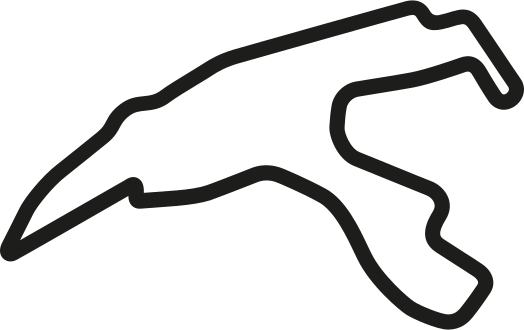
One of the most significant changes was the absence of the Belgian Grand Prix. In 2006, the FIA confirmed that Spa-Francorchamps would not feature on the calendar, as local authorities had begun extensive repair and upgrade work on the circuit, leaving insufficient time for completion ahead of the race. The decision was widely regretted within the paddock, given Spa’s status as one of the sport’s most revered venues. Its removal proved temporary, however, with the Belgian Grand Prix returning to the Formula One calendar in 2007.
2006 Formula 1 Race Reports
Round 1: Bahrain Grand Prix
Race date: 12 March
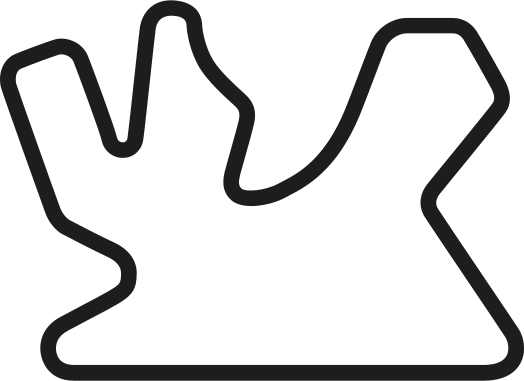
Circuit: Bahrain International Circuit, Sakhir
The season’s first race, the 2006 Bahrain Grand Prix, saw the debut of new qualifying rules earlier in the weekend, dividing the one-hour session into three knockout stages. Michael Schumacher clinched pole but it was the 2005 World Champion, Fernando Alonso and the Renault team who claimed the win.
Ferrari driver and polesitter Schumacher began his final season in Formula One (before his return with Mercedes in 2010) in second position. Kimi Raikkonen finished in third for McLaren, despite starting the race at the back of the gird.
Future world champion Nico Rosberg, son of World Champion Keke Rosberg, made his F1 debut with Williams while setting the race’s fastest lap and, at 20 years and 258 days old, became the youngest F1 driver to achieve this—a record he held until Max Verstappen broke it at age 19 during the 2016 Brazilian Grand Prix. The race also introduced the BMW Sauber, Toro Rosso, Midland F1, and Super Aguri teams to Formula 1, alongside new drivers Scott Speed and Yuji Ide.
Round 2: Malaysian Grand Prix
Race date: 19 March
Circuit: Sepang International Circuit
Renault driver Giancarlo Fisichella led from start to finish to secure his first Grand Prix victory in a year at the 2006 Malaysian Grand Prix, outpacing his teammate Fernando Alonso, who notched up his 25th podium finish. British driver Jenson Button achieved his first podium of the season for Honda, finishing third ahead of McLaren’s Juan Pablo Montoya.
Fisichella’s victory is the last for an Italian driver as of 2025. This was Renault’s first 1-2 finish since returning to F1 as a constructor in 2002 and also their first 1-2 finish overall since the 1982 French Grand Prix.
Formula One History Recommends
Round 3: Australian Grand Prix
Race date: 2 April
Circuit: Albert Park Circuit , Melbourne
At the 2006 Australian Grand Prix held at Albert Park, Fernando Alonso took first place for Renault, followed by Kimi Räikkönen in a McLaren and the Toyota of Ralf Schumacher.
The race was delayed due to the Commonwealth Games in Melbourne, deviating from its traditional slot as the season opener. The legendary F1 commentator Murray Walker returned to the commentary box for a special one-off with Australia’s Network Ten.
Round 4: San Marino Grand Prix
Race date: 23 April
Circuit: Autodromo Enzo e Dino Ferrari
Michael Schumacher secured victory at the 2006 San Marino Grand Prix at Imola, narrowly edging out the Renault of Fernando Alonso by less than two seconds after an intense race-long battle.
Meanwhile, Jenson Button was left furious after a botched pit stop cost him a podium finish. Running third on lap 30, Button pulled in for refueling when his lollipop man mistakenly lifted the ‘Stop’ board too early. As Button accelerated, the lollipop was slammed back down onto his helmet, forcing him to brake suddenly. In the confusion, the fuel nozzle was ripped off the hose, delaying his stop. By the time the issue was resolved, he had dropped to seventh, ending his hopes of a podium.
Round 5: European Grand Prix
Race date: 7 May
Circuit: Nürburgring , Nürburg
Michael Schumacher celebrated his 86th career victory at the 2006 European Grand Prix at the Nurburgring, giving new energy to the championship battle. However, the event was also characterised by Fernando Alonso‘s frustration at finishing second after starting from pole, as well as Bernie Ecclestone‘s critical remarks about his championship performance. The second Ferrari of Felipe Massa earned his first podium finish of the season with third place.
The weekend also hinted at Lewis Hamilton‘s future prospects in Formula 1, following his success in the GP2 series. While Franck Montagny made his Formula One debut, becoming the first French F1 driver since Olivier Panis at the 2004 Japanese Grand Prix.
Round 6: Spanish Grand Prix
Race date: 14 May
Circuit: Circuit de Catalunya , Montmeló
Renault driver Fernando Alonso dominated the 2006 Spanish Grand Prix to win in front of 131,000 home fans for the first time. For everybody other than the Spaniards, the race was entirely forgettable, as the only excitement hinged on whether Alonso would make a third pit stop and be caught by Michael Schumacher. He didn’t. Schumacher finished second in a Ferrari with Alonso’s teammate Giancarlo Fisichella third.
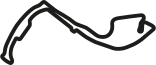
Round 7: Monaco Grand Prix
Race date: 28 May
Circuit: Circuit de Monaco , Monte Carlo
David Coulthard made history for Red Bull at the 2006 Monaco Grand Prix, ending his long absence from the podium by finishing third in Monte Carlo. Donning a Superman cape as part of Red Bull’s promotion for the Hollywood blockbuster “Superman Returns,” this was Coulthard’s first podium since Suzuka at the 2003 Japanese Grand Prix. The cape was the result of a bet between Coulthard and team boss Christian Horner; in return, Horner leapt naked into a swimming pool. “I got nervous as David moved through the field, but it was worth getting wet for this result,” Horner grinned.
Race winner Fernando Alonso claimed his first-ever win at the iconic street circuit with Juan Pablo Montoya finished second, earning what would be his final career podium. David Coulthard’s third came with Jarno Trulli suffered a late hydraulic failure. Coulthard’s result marked Red Bull Racing’s first-ever podium finish, as well as Ferrari’s first podium as an engine supplier for a customer team since the 2003 United States Grand Prix when Sauber—badged as Petronas—achieved the feat.
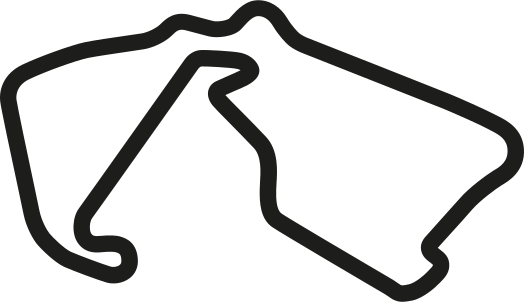
Round 8: British Grand Prix
Race date: 11 June
Circuit: Silverstone Circuit , Silverstone
Fernando Alonso edged closer to clinching the world championship with a win at the 2006 British Grand Prix, his 14th consecutive podium finish. “So far it has been fantastic, with five wins and three seconds,” he remarked, praising the flawless performance and the team’s efforts.
Michael Schumacher took second for Ferrari and Finn Kimi Raikkonen third for McLaren.
This race also featured the first ever pit stop to have involved a woman, during a Midland F1 pit stop for Tiago Monteiro, ITV-F1’s then pit-lane reporter Louise Goodman was the left rear tyre changer.
Round 9: Canadian Grand Prix
Race date: 25 June
Circuit: Circuit Gilles Villeneuve , Montreal
Fernando Alonso took a step closer to clinching his second consecutive Formula One drivers’ championship with a victory at the 2006 Canadian Grand Prix. Driving for Renault, this win became his fourth consecutive win of the season and the sixth of that year. Ferrari’s Michael Schumacher, starting from fifth, capitalised on late-race incidents to finish second, while McLarens‘ Kimi Räikkönen, who started third, completed the podium in third place.
The race featured several incidents, including a first-lap collision between the Midland teammates, resulting in Christijan Albers‘ retirement and Tiago Monteiro‘s compromised race. Local favourite Jacques Villeneuve retired on lap 58 due to brake failure, bringing out the safety car. This allowed Schumacher to close the gap to Räikkönen, whom he overtook on lap 69 after a Räikkönen error. Alonso’s victory extended his lead in the Drivers’ Championship to 84 points, 25 ahead of Schumacher, while Renault maintained their lead in the Constructors’ Championship with 121 points.
Round 10: United States Grand Prix
Race date: 2 July
Circuit: Indianapolis Motor Speedway , Speedway
Michael Schumacher won a gruelling 2006 United States Grand Prix, with only nine cars making it to the finish. Felipe Massa initially led the race following Ferrari’s dominant performance in qualifying, but Schumacher took the lead after the pit stops. Mass would finish second with Giancarlo Fisichella securing third place, followed by Jarno Trulli in the Toyota.
Fernando Alonso finished fifth in the second Renault, maintaining a 19-point lead over Schumacher in the championship standings.
Round 11: French Grand Prix
Race date: 16 July
Circuit: Circuit de Nevers Magny-Cours , Magny-Cours
Michael Schumacher made history by becoming the first driver to win the same Grand Prix— the French—eight times during the 2006 French Grand Prix. His dominance in the race also earned him his 22nd career hat trick (pole position, win, and fastest lap in the same race), setting another record.
Fernando Alonso, driving a Renault at the team’s home race, finished second, whilst Schumacher’s Ferrari team-mate, Felipe Massa, completed the podium by finishing in third position.
It was also the 68th and final pole position of Michael Schumacher’s career. Schumacher held the record for the most pole positions until Lewis Hamilton beat it at the 2017 Italian Grand Prix.
Round 12: German Grand Prix
Race date: 30 July
Circuit: Hockenheimring
Michael Schumacher clinched his fourth home win at the 2006 German Grand Prix with a commanding performance in front of his home fans. Felipe Massa completed a straightforward day for Ferrari by coming home in second. The main excitement came from a third-place battle between Kimi Raikkonen and Jenson Button, with Raikkonen overtaking Button’s Honda in the final laps.
The weekend had begun amid controversy when Renault’s use of a mass damper system was ruled legal by the event stewards, despite the FIA having previously banned such devices. In response, the FIA lodged an appeal against the stewards’ decision, prompting Renault to remove the system after Friday practice in order to avoid potential penalties.
Round 13: Hungarian Grand Prix
Race date: 6 August
Circuit: Hungaroring
Jenson Button finally clinched his first Formula One victory at the 2006 Hungarian Grand Prix with Honda, an achievement that had long eluded him. Starting 14th on the grid, Button navigated the wet weather conditions and capitalised on a safety car appearance to move up to second place behind Renault driver Fernando Alonso. However, disaster struck for Alonso on lap 51 when a loose wheel nut forced him out of the race, paving the way for Button to secure his maiden win on his 113th attempt.
Pedro de la Rosa secured second place for McLaren-Mercedes, achieving the only podium finish of his career, while Nick Heidfeld finished third, earning BMW Sauber their first-ever podium.
There were other notable events of the 2006 Hungarian Grand Prix. It was the final victory for a Honda engine in Formula One until Max Verstappen won the 2019 Austrian Grand Prix for Red Bull. It marked the last time Honda secured a victory as a full constructor in Formula One. This race also featured the last all-Michelin podium to date. And, the race also marked the debut of Robert Kubica for BMW Sauber, making him Poland’s first-ever F1 driver. Kubica initially finished seventh but was later disqualified for his car being underweight.
Round 14: Turkish Grand Prix
Race date: 27 August
Circuit: Istanbul Park
Ferrari driver Felipe Massa secured his first pole position at the 2006 Turkish Grand Prix and went on to claim his maiden race victory. Fernando Alonso, driving for Renault, finished in second place, while Massa’s teammate, Michael Schumacher, completed the podium in third.
This event also marked the debut Grand Prix weekend for future four-time world champion Sebastian Vettel, who served as a Friday test driver for the BMW Sauber team. Vettel was fined $1,000 for speeding in the pit lane just six seconds after first entering the track.
Additionally, this race celebrated the 200th Grand Prix for the McLaren–Mercedes engine partnership, which began in 1995.
Round 15: Italian Grand Prix
Race date: 10 September
Circuit: Autodromo Nazionale di Monza
The 2006 Italian Grand Prix marked Kimi Raikkonen‘s 100th career start in Formula 1. However, there was no fairytale win for the McLaren driver, as Michael Schumacher, running two laps longer than Raikkonen, used his strategic advantage to secure victory. Raikkonen settled for second ahead of Sauber driver Robert Kubica in thrid.
The race was Schumacher’s 90th victory. On the same day, Schumacher announced his first retirement from Formula One at the end of the 2006 F1 season. He would return with Mercedes in 2010.
Round 16: Chinese Grand Prix
Race date: 1 October
Circuit: Shanghai International Circuit, Shanghai
The 91st and last Formula One win for Michael Schumacher came at the 2006 Chinese Grand Prix, which drew him level in the drivers’ standings with Fernando Alonso, who came second in his Renault. Alonso had been leading by 19 seconds from his teammate Giancarlo Fisichella when he pitted on the 22nd lap, but a mistake with his tyres cost him dearly. “The decision to switch Fernando to new intermediate tyres at his first stop was taken jointly and obviously cost him time as he waited for them to scrub in,” said Michelin F1 director Nick Shorrock. “With the benefit of hindsight, that was a mistake, but in the heat of a race, split-second decisions have to be taken.” Schumacher passed Fisichella when the pair pitted and was never caught.
Round 17: Japanese Grand Prix
Race date: 8 October
Circuit: Suzuka Circuit , Suzuka
Fernando Alonso put one hand on his second world Drivers’ trophy with victory at the 2006 Japanese Grand Prix after Michael Schumacher retired with an engine failure. The pair arrived at the Suzuka circuit level on points, but after Ferrari outpaced Renault in qualifying it looked as though Schumacher would win and take a points advantage to the final round in Brazil, where he had planned to retire from F1 after the race. However, on lap 36 a plume of white smoke came from the right bank of his Ferrari V8 and he pulled aside at the exit of Degner 2. As Alonso drove past he gave Schumacher a cheeky wave before continuing on to victory and a 10-point lead in the title chase. After the race, Schumacher admitted that his title aspirations were over despite the slim chance of victory if Alonso retired from Brazil. “As for the drivers’ championship, it is lost,” he said. “I don’t want to head off for a race, hoping that my rival has to retire. That is not the way in which I want to win the title.”
Ferrari teammate Felipe Massa finished third, while Alonso’s teammate, Giancarlo Fisichella, finished third.
Round 18: Brazilian Grand Prix
Race date: 22 October
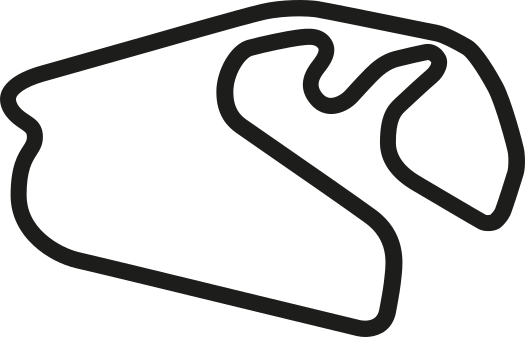
Circuit: Autódromo José Carlos Pace , São Paulo
It appeared to be the end of an era when Michael Schumacher finished fourth at the 2006 Brazilian Grand Prix, his final race for Ferrari after an iconic career. Schumacher needed to win and for Fernando Alonso to score no points to secure an eighth world title, but his hopes were dashed when he suffered a puncture following contact with Giancarlo Fisichella in the Renault. Though Schumacher fought his way back from 20th to finish fourth, Alonso cruised to second, securing his second consecutive championship and helping Renault secure the Constructors’ title.
Local hero Felipe Massa took the win for Ferrari, and Brit Jenson Button came home in third for Honda.
Seeming to be his last-ever F1 race, tributes to Schumacher poured in, with Mika Hakkinen predicting that Schumacher would eventually return to racing, as he could never stay away for long. He would. He returned with Mercedes in 2010, racing with the team till the end of 2012.
2006 Formula 1 Race Results
Grands Prix
2006 Formula 1 Standings
Driver standings
| Pos | Driver | Nationality | Car | PTS |
|---|---|---|---|---|
| 1 | Fernando Alonso | ESP | Renault | 134 |
| 2 | Michael Schumacher | GER | Ferrari | 121 |
| 3 | Felipe Massa | BRA | Ferrari | 80 |
| 4 | Giancarlo Fisichella | ITA | Renault | 72 |
| 5 | Kimi Räikkönen | FIN | McLaren Mercedes | 65 |
| 6 | Jenson Button | GBR | Honda | 56 |
| 7 | Rubens Barrichello | BRA | Honda | 30 |
| 8 | Juan Pablo Montoya | COL | McLaren Mercedes | 26 |
| 9 | Nick Heidfeld | GER | Sauber BMW | 23 |
| 10 | Ralf Schumacher | GER | Toyota | 20 |
| 11 | Pedro de la Rosa | ESP | McLaren Mercedes | 19 |
| 12 | Jarno Trulli | ITA | Toyota | 15 |
| 13 | David Coulthard | GBR | RBR Ferrari | 14 |
| 14 | Mark Webber | AUS | Williams Cosworth | 7 |
| 15 | Jacques Villeneuve | CAN | Sauber BMW | 7 |
| 16 | Robert Kubica | POL | Sauber BMW | 6 |
| 17 | Nico Rosberg | GER | Williams Cosworth | 4 |
| 18 | Christian Klien | AUT | RBR Ferrari | 2 |
| 19 | Vitantonio Liuzzi | ITA | STR Cosworth | 1 |
| 20 | Scott Speed | USA | STR Cosworth | 0 |
| 21 | Tiago Monteiro | POR | MF1 Toyota | 0 |
| 22 | Christijan Albers | NED | MF1 Toyota | 0 |
| 23 | Takuma Sato | JPN | Super Aguri Honda | 0 |
| 24 | Robert Doornbos | NED | RBR Ferrari | 0 |
| 25 | Yuji Ide | JPN | Super Aguri Honda | 0 |
| 26 | Sakon Yamamoto | JPN | Super Aguri Honda | 0 |
| 27 | Franck Montagny | FRA | Super Aguri Honda | 0 |
Team standings
| Pos | Team | PTS |
|---|---|---|
| 1 | Renault | 206 |
| 2 | Ferrari | 201 |
| 3 | McLaren Mercedes | 110 |
| 4 | Honda | 86 |
| 5 | Sauber BMW | 36 |
| 6 | Toyota | 35 |
| 7 | RBR Ferrari | 16 |
| 8 | Williams Cosworth | 11 |
| 9 | STR Cosworth | 1 |
| 10 | MF1 Toyota | 0 |
| 11 | Super Aguri Honda | 0 |