
















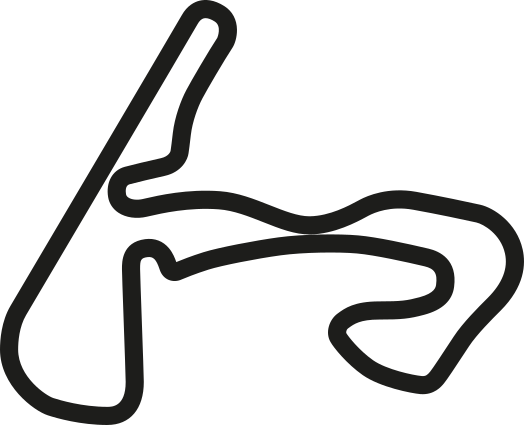

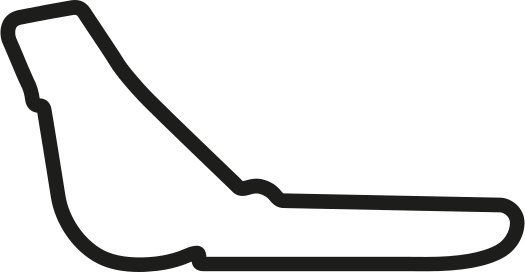
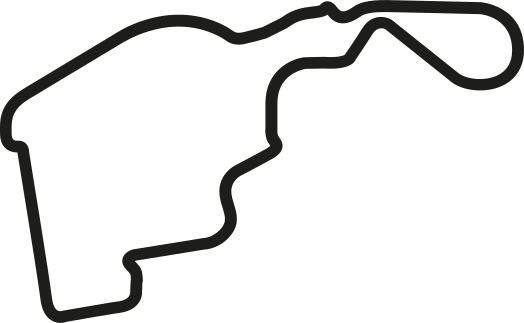

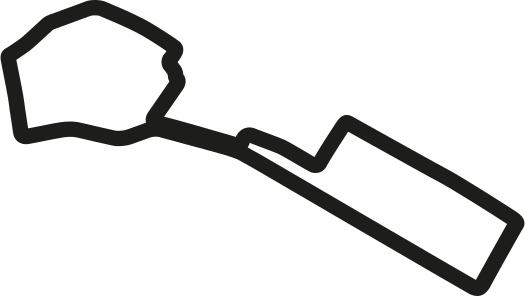









The 2009 FIA Formula One World Championship marked the 60th running of the championship, unfolding across 17 races beginning with the Australian Grand Prix on 29 March and concluding with the inaugural Abu Dhabi Grand Prix on 1 November, the first Formula One race held at the Yas Marina Circuit.
Season
The season ultimately belonged to Jenson Button and the remarkable Brawn GP team. Button secured the Drivers’ World Championship at the Brazilian Grand Prix, the penultimate round of the season, while Brawn simultaneously clinched the Constructors’ Championship. Both titles represented historic firsts: it was Button’s only world championship victory and Brawn GP’s only season in Formula One. The team had been formed only months earlier following a management buyout of the departing Honda team, making Brawn GP the first team in Formula One history to win the Constructors’ Championship in its debut season. When the team was later sold to Mercedes for the 2010 season, it also left Brawn GP with the unique distinction of winning 100 per cent of the championships in which it competed.
Button’s triumph also added to Britain’s strong presence in Formula One during this period. He became the tenth British driver to win the world championship, and following Lewis Hamilton’s title in 2008, it marked the first time that English drivers had won the championship in consecutive seasons. It was also the first instance of back-to-back British champions since Graham Hill in 1968 and Jackie Stewart in 1969.
Although Brawn dominated the early part of the season, the competitive landscape evolved significantly as the year progressed. Red Bull Racing emerged as Brawn’s primary challenger and enjoyed its most successful campaign to that point in Formula One. By contrast, the established front-running teams of Ferrari and McLaren, both dominant forces in the previous season, struggled to replicate their 2008 form and endured unexpectedly difficult campaigns.
Ten teams contested the championship in 2009. The grid had been shaped by a number of sweeping regulation changes introduced by the FIA, many of which were aimed at reducing costs during a period of economic uncertainty while also improving the quality of on-track racing. Among the most visible technical changes was the return of slick tyres, last used in Formula One in 1997. The reintroduction of fully smooth dry-weather tyres significantly increased mechanical grip. The cars themselves were also dramatically altered through major aerodynamic revisions, designed to reduce turbulence and make overtaking easier. Another significant innovation was the introduction of Kinetic Energy Recovery Systems (KERS), which allowed drivers to capture energy during braking and deploy it for a temporary power boost.
The team that adapted most effectively to the new regulations was Brawn GP. Having inherited Honda’s previously developed car but refining it to exploit the updated rules — most famously through its controversial yet legal double-diffuser design — the team made a stunning start to the season. Brawn won six of the first seven races, allowing Button to establish a commanding championship lead early in the year.
However, the competitive balance shifted during the second half of the season as Red Bull Racing rapidly improved its performance. The title battle tightened as Red Bull’s drivers began challenging for victories, creating a far less predictable championship than the opening races had suggested. Button’s main rivals ultimately came from three drivers: Sebastian Vettel, Rubens Barrichello, and Mark Webber. Vettel drove for Red Bull, while Barrichello was Button’s teammate at Brawn, and Webber partnered Vettel at Red Bull. Between them, the trio secured eight race victories across the season and finished second, third, and fourth in the final Drivers’ Championship standings.
The season also marked a notable statistical milestone for the sport. For the first time since 2005, every team competing in the championship scored World Championship points at least once during the year, highlighting the relatively competitive spread of results across the grid.
In historical terms, the 2009 championship carried several long-lasting distinctions. It was the last time a British-licensed constructor won the Constructors’ Championship until McLaren achieved the feat in 2024. The year also marked the return of fully slick tyres to Formula One, ending the era of grooved tyres introduced in 1998 to reduce cornering speeds.
The season also represented the final chapter for two long-standing elements of the sport’s race format. 2009 was the last year to use the points system introduced in 2003, which awarded points to the top eight finishers on a 10–8–6–5–4–3–2–1 scale. It was also the final season to feature in-race refuelling during pit stops, a practice that had been permitted continuously since the 1994 season. Beginning in 2010, refuelling would be banned, fundamentally changing race strategy and the way teams approached Grand Prix weekends.
Regulation Changes
The 2009 Formula One season introduced one of the most sweeping sets of technical rule changes in the sport’s modern history. Many of the regulations had originally been outlined by the FIA on 22 December 2006, but they were revised several times before implementation. These revisions reflected the recommendations of the Overtaking Working Group, which had been established in response to concerns that overtaking had become increasingly rare in Formula One, as well as the growing pressure to reduce costs across the sport.
One of the most visible changes was the return of slick tyres, which had been banned since the end of the 1997 season. With no grooves cut into the tyre surface, slick tyres provided significantly more mechanical grip. Bridgestone continued as the championship’s sole tyre supplier, and drivers were still required to use both tyre compounds during a race. The softer compound tyres were now marked by a green stripe around the sidewall, replacing the white marking previously used in the grooves of grooved tyres. The tyre naming system was also adjusted: the tyres previously referred to as wet tyres were renamed intermediates, while the tyres designed for the heaviest rainfall were now simply called wet tyres.
Perhaps the most dramatic transformation came in the area of aerodynamics. The FIA introduced radical revisions designed to reduce aerodynamic turbulence and make it easier for drivers to follow one another closely. The front wing was made significantly lower and wider, while the rear wing became higher and narrower. At the same time, many of the small aerodynamic devices that had proliferated on Formula One cars during the preceding seasons — including winglets, barge boards, and turning vanes — were banned. This resulted in cars with much cleaner, smoother bodywork, making the 2009 machines visually distinct from their predecessors. The rear diffuser was also repositioned further back and raised slightly, while numerous smaller chassis components were standardised. Together with the return of slick tyres, these aerodynamic changes aimed to reduce reliance on downforce and increase mechanical grip, thereby encouraging closer racing and more overtaking.
For the first time, Formula One also allowed driver-adjustable aerodynamic bodywork. Drivers were permitted to alter the angle of small flaps on the front wing by up to six degrees, although adjustments were limited to two changes per lap. The feature was designed to help drivers regain downforce when running behind another car, another attempt to improve overtaking opportunities.
A major technological innovation also appeared in the form of Kinetic Energy Recovery Systems (KERS). These systems captured energy generated during braking — energy that would normally be lost as heat — and stored it either electrically, using batteries or supercapacitors, or mechanically, using a flywheel. Drivers could then deploy the stored energy using a button on the steering wheel to gain a temporary acceleration boost. The regulations limited the extra output to roughly 82 horsepower (61 kW), delivering 400 kJ of energy for up to six seconds per lap. The system was optional rather than mandatory, and due to concerns about reliability, safety, and limited performance gains, only four teams chose to use KERS during the season.
Alongside these technical adjustments, the FIA also introduced several measures aimed at reducing costs across the sport. Plans to introduce a formal budget cap were initially discussed but ultimately abandoned when teams could not agree on an acceptable limit. Instead, other restrictions were implemented. In-season testing was completely banned, wind tunnel usage was reduced, and teams were required to share more operational data during race weekends. Engine and gearbox durability requirements were also tightened. Gearboxes still had to last four races, with a five-place grid penalty applied if a driver replaced one before the permitted limit.
Engine usage was also restricted further. Each driver was allowed to use a maximum of eight engines during the season, plus four additional engines for practice and testing. Exceeding this limit resulted in a ten-place grid penalty for each additional engine used. To help improve reliability, engine performance was slightly reduced by lowering the maximum engine speed from 19,000 rpm to 18,000 rpm.
Race weekend procedures were also adjusted. The rule introduced in 2007 that closed the pit lane during a safety car period was removed for 2009. The rule had originally been implemented to prevent drivers rushing into the pits to refuel while passing through potentially dangerous areas of the circuit, but improvements in software monitoring made the restriction unnecessary. At the same time, the pit lane speed limit was increased from 50 mph (80 km/h) to 62 mph (100 km/h).
In the lead-up to the season, the FIA briefly attempted to introduce a controversial change to the way the Drivers’ Championship would be decided. The governing body initially announced that the driver with the most race victories would automatically become world champion, regardless of total points scored. The proposal was met with strong opposition from teams and drivers, with the Formula One Teams Association (FOTA) arguing that such a major rule change could not be implemented so close to the start of the season without full agreement from all competitors. Faced with this resistance, the FIA ultimately abandoned the idea.
Other proposals were also discussed but never implemented. Among them were suggestions for a new points system, awarding points on a 12–9–7–5–4–3–2–1 scale, and the possibility of awarding medals to the top three finishers instead of relying solely on points. Both ideas were ultimately rejected, leaving the championship to continue using the existing 10–8–6–5–4–3–2–1 scoring system that had been in place since 2003.
2009 F1 Entries Drivers and Teams
The teams and drivers listed below competed in the 2009 FIA Formula One World Championship. Car numbers are shown exactly as they appeared on the official FIA 2009 entry list. Team information follows the Formula 1 official website unless otherwise stated. In keeping with long-standing Formula One tradition, car number 13 was not allocated. Teams competed with tyres supplied by Bridgestone.
| Entrant | Constructor | Chassis | Engine | No. | Race drivers | Rounds |
|---|---|---|---|---|---|---|
| Vodafone McLaren Mercedes | McLaren-Mercedes | MP4-24 | Mercedes FO 108W | 1 | Lewis Hamilton | All |
| 2 | Heikki Kovalainen | All | ||||
| Scuderia Ferrari Marlboro | Ferrari | F60 | Ferrari 056 | 3 | Felipe Massa | 1–10 |
| Luca Badoer | 11–12 | |||||
| Giancarlo Fisichella | 13–17 | |||||
| 4 | Kimi Räikkönen | All | ||||
| BMW Sauber F1 Team | BMW-Sauber | F1.09 | BMW P86/9 | 5 | Robert Kubica | All |
| 6 | Nick Heidfeld | All | ||||
| Renault F1 Team | Renault | R29 | Renault RS27 | 7 | Fernando Alonso | All |
| 8 | Nelson Piquet Jr. | 1–10 | ||||
| Romain Grosjean | 11–17 | |||||
| Panasonic Toyota Racing | Toyota | TF109 | Toyota RVX-09 | 9 | Jarno Trulli | All |
| 10 | Timo Glock | 1–15 | ||||
| Kamui Kobayashi | 16–17 | |||||
| Scuderia Toro Rosso | Toro Rosso-Ferrari | STR4 | Ferrari 056 | 11 | Sébastien Bourdais | 1–9 |
| Jaime Alguersuari | 10–17 | |||||
| 12 | Sébastien Buemi | All | ||||
| Red Bull Racing | Red Bull-Renault | RB5 | Renault RS27 | 14 | Mark Webber | All |
| 15 | Sebastian Vettel | All | ||||
| AT&T Williams Racing | Williams-Toyota | FW31 | Toyota RVX-09 | 16 | Nico Rosberg | All |
| 17 | Kazuki Nakajima | All | ||||
| Force India F1 Team | Force India-Mercedes | VJM02 | Mercedes FO 108W | 20 | Adrian Sutil | All |
| 21 | Giancarlo Fisichella | 1–12 | ||||
| Vitantonio Liuzzi | 13–17 | |||||
| Brawn GP Formula 1 Team | Brawn-Mercedes | BGP 001 | Mercedes FO 108W | 22 | Jenson Button | All |
| 23 | Rubens Barrichello | All |
Free Practice Drivers
Only one constructor used a dedicated free practice driver during the 2009 season. Toyota gave Japanese driver Kamui Kobayashi an opportunity to participate in the opening practice session at his home event, the Japanese Grand Prix. The appearance marked Kobayashi’s first official Formula One running during a Grand Prix weekend and formed part of Toyota’s efforts to develop young talent within its driver programme.
Team Changes
The most dramatic structural change ahead of the 2009 season came when Honda withdrew from Formula One at the end of 2008 amid the global financial crisis. Rather than disappearing entirely, the team was saved through a management buyout led by team principal Ross Brawn. The newly formed organisation was renamed Brawn GP, and although it retained much of Honda’s existing staff and infrastructure, it switched to Mercedes engines for its debut season.
Despite the ownership change, the team’s driver line-up remained intact. Jenson Button and Rubens Barrichello, who had both raced for Honda in 2008, continued with the new Brawn operation. The partnership would soon prove remarkably successful, as the team emerged as one of the dominant forces of the season.
Another team to change engine suppliers was Force India. After using Ferrari power units during the 2008 season, the team entered 2009 with Mercedes engines, strengthening its technical relationship with the German manufacturer and aligning itself more closely with the engine supplier used by Brawn GP and McLaren.
Driver Changes
The driver market was relatively stable heading into the 2009 season, with only one change taking place during the winter break. The long-serving David Coulthard retired from Formula One after a career spanning 14 seasons. The Scottish driver left Red Bull Racing at the end of 2008, bringing to a close one of the sport’s most enduring careers. His seat at Red Bull was filled by Sebastian Vettel, who had impressed during the previous season while racing for Scuderia Toro Rosso.
Vettel’s promotion created a vacancy at Toro Rosso, which was filled by Sébastien Buemi. The Swiss driver had served as Red Bull’s test driver in 2008 and was promoted to a full-time race seat for the 2009 championship.
Driver changes continued as the season progressed. After the German Grand Prix, Toro Rosso decided to part ways with Sébastien Bourdais. Team principal Franz Tost stated that the partnership had failed to deliver the results the team had hoped for. Bourdais was replaced by Spanish driver Jaime Alguersuari, who joined the team ahead of the Hungarian Grand Prix. Alguersuari had been competing in the Formula Renault 3.5 Series earlier in 2009 and had only recently signed with Toro Rosso as a test driver, replacing Brendon Hartley just two weeks before his unexpected promotion to the race seat. Following his dismissal, Bourdais was advised by legal counsel to pursue a breach-of-contract claim against the team. The dispute was eventually resolved when Toro Rosso agreed to pay $2.1 million to settle the matter and avoid litigation.
The Hungarian Grand Prix weekend also had significant consequences elsewhere on the grid. During qualifying, Felipe Massa suffered a serious accident when he was struck on the helmet by a suspension spring that had detached from another car. The impact left the Ferrari driver injured and forced him to miss the remainder of the season. Ferrari initially replaced Massa with the team’s veteran test driver Luca Badoer for the next two races. However, after Badoer failed to score any points in his appearances, Ferrari opted for a different solution. Giancarlo Fisichella, who had been racing for Force India during the 2009 season and had already signed an agreement to become Ferrari’s test driver for 2010, was brought in to replace Badoer for the remainder of the year. Fisichella’s departure from Force India opened a seat that was filled by the team’s reserve driver Vitantonio Liuzzi.
Renault also made a mid-season driver change shortly after the Hungarian Grand Prix. The team parted ways with Nelson Piquet Jr., who had failed to score a single point during the first half of the season. Around the same time, allegations surfaced regarding Piquet’s involvement in the deliberate crash that had influenced the outcome of the 2008 Singapore Grand Prix. Renault replaced him with their test driver Romain Grosjean, who was promoted to a full-time race seat for the remainder of the championship.
Toward the end of the season, attention also turned to the future of Kimi Räikkönen. The 2007 World Champion confirmed that he would leave Ferrari after the 2009 season, while the team simultaneously announced that Fernando Alonso would join the Scuderia for 2010, signalling a major shift in the driver market.
Further driver changes were prompted by injury. During qualifying for the Japanese Grand Prix, Toyota’s Timo Glock suffered a heavy crash at the final corner of the Suzuka circuit and was airlifted to hospital with a leg injury. Glock was declared unfit to race, leaving Jarno Trulli as Toyota’s sole driver for the event. Subsequent examinations revealed additional complications from the accident, including a cracked vertebra, casting doubt over Glock’s ability to return before the end of the season.
As a result, Toyota confirmed on 11 October that its test driver Kamui Kobayashi would make his Formula One race debut at the Brazilian Grand Prix. Kobayashi continued in the seat for the final race of the season in Abu Dhabi.
2009 Formula 1 Race Calendar
Calendar Changes
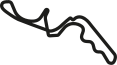
The 2009 Formula One calendar introduced several adjustments, including the debut of a brand-new venue and the removal of two established races. The most notable addition was the Abu Dhabi Grand Prix, which appeared on the championship schedule for the first time. The race was held at the newly constructed Yas Marina Circuit, located on Yas Island in Abu Dhabi, and served as the final round of the season on 1 November. The circuit quickly became one of the sport’s most distinctive venues, combining a modern track layout with a unique twilight start that saw the race begin in daylight and finish under floodlights.
Japan’s race also moved to a different circuit for 2009. The Japanese Grand Prix returned to the historic Suzuka Circuit in Suzuka after being held at Fuji Speedway in Oyama during the previous two seasons. Suzuka, long regarded as one of the most challenging and popular circuits on the Formula One calendar, resumed its place as the host venue for the country’s Grand Prix.
Two races originally scheduled for the season were ultimately removed from the calendar. The Canadian Grand Prix, which had been planned for 7 June, was cancelled due to a combination of sponsorship issues and contractual disputes between the organisers and Formula One’s commercial management. In order to maintain the structure of the championship, the Turkish Grand Prix was moved into the vacant slot on the schedule. Canada’s race would eventually return to the Formula One calendar the following year.
The French Grand Prix also disappeared from the 2009 calendar. Initially scheduled for 28 June at the Circuit de Nevers Magny-Cours, the event was cancelled after the withdrawal of financial support from the French government. The absence of the race marked the first time in decades that France did not host a Formula One Grand Prix. The French Grand Prix would remain absent from the championship for several years before eventually returning in 2018, this time at the Circuit Paul Ricard.
2009 Formula 1 Race Reports
Round 1: Australian Grand Prix
Race date: 29 March
Circuit: Albert Park Circuit , Melbourne
The season-opening 2009 Australian Grand Prix became a spectacular debut for the newly formed Brawn GP team, with Jenson Button clinching their first pole position and Rubens Barrichello completing the front row. On race day, Button led a dominant 1-2 finish for Brawn GP, with them becoming the first constructor since Mercedes in 1954 at the French Grand Prix to secure a pole and win on their debut. It was Button’s second F1 win and his first since the 2006 Hungarian Grand Prix. The race also celebrated Jarno Trulli‘s 200th Grand Prix, with him taking third for Toyota. The race also saw the re-introduction of slick tyres since the 1997 European Grand Prix, moving away from the grooved tyres F1 had become known for.
Round 2: Malaysian Grand Prix
Race date: 5 April
Circuit: Sepang International Circuit
Jenson Button secured the second of his remarkable six consecutive wins at the start of the season for Brawn GP at the 2009 Malaysian Grand Prix, though it was far from the most enjoyable victory. A torrential downpour transformed the Sepang circuit into a lake, leaving Button and the other drivers stranded on the grid as they waited for conditions to improve. The final 50 minutes were spent watching the rain fall and the clock run down. The Times observed, “The only unexpected aspect was that when the rain came, it did so in dribs and drabs to start with, rather than via a sudden cloudburst, and this played a big role in the final outcome as teams struggled to respond with their tyre strategy.”
As the race failed to reach the required 75% distance (42 laps) for full points to be awarded, half-points were given instead, for only the fifth time in Formula One history and the first since the 1991 Australian Grand Prix. Nick Heidfeld was classified second for BMW Sauber with Timo Glock third for Toyota.
Formula One History Recommends
Round 3: Chinese Grand Prix
Race date: 19 April
Circuit: Shanghai International Circuit, Shanghai
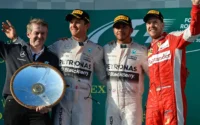
Sebastian Vettel delivered Red Bull Racing’s first-ever Formula One victory with a commanding performance at the 2009 Chinese Grand Prix. Having previously secured Toro Rosso’s maiden win the previous season, Vettel once again made history, starting from pole position and leading a dominant 1-2 finish for Red Bull alongside teammate Mark Webber.
Behind them, Brawn GP’s Jenson Button and Rubens Barrichello continued their strong early-season form, finishing third and fourth, respectively. The result marked a major milestone for Red Bull Racing, who have since gone on to be one of the most successful teams in F1 history.
During the podium ceremony, there was confusion when “God Save the Queen”, the British national anthem, was played for winning constructor Red Bull instead of “Land der Berge, Land am Strome”, the Austrian national anthem.
Formula One History Recommends
Round 4: Bahrain Grand Prix
Race date: 26 April
Circuit: Bahrain International Circuit, Sakhir
Jenson Button continued his sensational start to the 2009 season, securing his third victory in four races with a hard-fought win at the 2009 Bahrain Grand Prix for Brawn GP. He would go on to win six of the first seven races, all but securing his path to the 2009 World Championship.
Unlike some of his earlier dominant performances, Bahrain proved to be a tougher challenge. Button executed a crucial overtaking move on the McLaren of Lewis Hamilton, creating enough of a gap to keep the Red Bull of Sebastian Vettel at bay.
Toyota had locked out the front row in qualifying, raising hopes of a maiden victory. However, their challenge fizzled out after the first round of pit stops, leaving Button to control the race and take another decisive step toward the title he would win. Vettel finished second and Jarno Trulli finished third for Toyota.
Round 5: Spanish Grand Prix
Race date: 10 May
Circuit: Circuit de Catalunya , Montmeló
The 2009 Spanish Grand Prix saw a one-two finish for Brawn GP, with Jenson Button securing his fourth victory of the season, followed by his teammate Rubens Barrichello, who finished 13 seconds behind. Mark Webber claimed third place, while his Red Bull teammate, Sebastian Vettel, finished fourth.
Lower down the field, Nick Heidfeld finished seventh, but in doing so, he broke Michael Schumacher’s record of 24 consecutive race finishes, a streak that has since been surpassed serval times over by the likes of Lewis Hamilton and Max Verstappen.
Round 6: Monaco Grand Prix
Race date: 24 May
Circuit: Circuit de Monaco , Monte Carlo
Brawn GP driver Jenson Button won the 2009 Monaco Grand Prix, a highlight in his championship-winning year, even though he missed out on winning his home race at Silverstone. Button and his Brawn teammate Rubens Barrichello dominated, finishing first and second. After the race, Button mistakenly returned to the pits instead of parking on the start-finish straight, as per Monaco tradition. Nonetheless, he enjoyed a solo run from the pits to the podium, cheered by his team and fans. Reflecting on his victory, Button said, “Winning the Monaco Grand Prix is something you dream about as a child and as a racing driver, and the reality of taking that victory just feels awesome.” Kimi Raikkonen completed the podium in third for Ferrari.
Round 7: Turkish Grand Prix
Race date: 7 June
Circuit: Istanbul Park, Istanbul
Jenson Button emerged victorious at the 2009 Turkish Grand Prix, extending his championship lead over teammate Rubens Barrichello to 26 points.
Mark Webber and Sebastian Vettel for Red Bull Racing completed the podium. Vettel started the race on pole, but a mistake on the first lap scuppered his chances of the win, which went to the Brawn GP driver Button.
Round 8: British Grand Prix
Race date: 21 June
Circuit: Silverstone Circuit , Silverstone
Sebastian Vettel triumphed for Red Bull Racing at the 2009 British Grand Prix, leading from start to finish ahead of his teammate Mark Webber and Brawn GP’s Rubens Barrichello.
Vettel’s commanding performance was complemented by Webber, who overtook Barrichello during the pit stops. Championship leader Jenson Button struggled in the sister Brawn GP car, finishing sixth after losing three places at the start.
Round 9: German Grand Prix
Race date: 12 July
Circuit: Nürburgring, Nürburg
Mark Webber achieved his first F1 pole and win at the 2009 German Grand Prix despite receiving a drive-through penalty for clipping the Brawn GP car of Rubens Barrichello on the first corner. It was a tough day for Barrichello and teammate Jenson Button, whose early-season dominance faded as they struggled with three-stop strategies, ultimately finishing sixth and fifth, respectively.
Sebastian Vettel came in second, giving Red Bull their third 1-2 finish of 2009. Felipe Massa finished third for Ferrari.
In the sister Red Bull team this was the last race for Toro Rosso driver Sebastien Bourdais who was dropped in favour of test driver Jaime Alguersuari for the 2009 Hungarian Grand Prix.
Formula One History Recommends
Round 10: Hungarian Grand Prix
Race date: 26 July
Circuit: Hungaroring , Mogyoród
Lewis Hamilton celebrated his tenth Grand Prix victory by winning the 2009 Hungarian Grand Prix after starting from fourth place on the grid.
The 2007 world champion, Kimi Räikkönen, secured second for Ferrari, while the Red Bull of Mark Webber finished third. Brawn GP driver and Championship leader Jenson Button had a disappointing race, finishing seventh and losing ground to Webber in the championship standings.
Hamilton’s victory was his first since the 2008 Chinese Grand Prix, marking his return to the podium. It was also notable for being the first win for a car equipped with a regenerative brake system (KERS). Räikkönen’s second place was Ferrari’s best result of the season, with his teammate Felipe Massa suffering a freak and serious accident during the second part of Saturday’s qualifying session, resulting in a fractured skull.
The race also saw the debut of World Series by Renault racer and 2008 British Formula Three champion Jaime Alguersuari. At 19 years and 125 days old, he became the youngest F1 driver in the championship’s 59-year history and the first born in the 1990s, a record later broken by Max Verstappen in 2015. Alguersuari replaced the ousted Sebastien Bourdais at Toro Rosso.
Round 11: European Grand Prix
Race date: 23 August
Circuit: Valencia Street Circuit, Valencia
Rubens Barrichello claimed victory for Brawn GP after starting from third on the grid at the 2009 European Grand Prix. The 2008 world champion, Lewis Hamilton, finished second for McLaren, while the 2007 world champion, Kimi Räikkönen, took third place for Ferrari. Championship leader Jenson Button finished seventh for the second consecutive race but extended his lead as both Red Bull Racing drivers, Mark Webber and Sebastian Vettel, failed to score points.
This win was Barrichello’s first Grand Prix victory since the 2004 Chinese Grand Prix, a gap of 85 races during which he was driving for Ferrari. His triumph also marked the 100th victory for a Brazilian driver in Formula One. Notably, there were no overtakes recorded during this race.
Round 12: Belgian Grand Prix
Race date: 30 August
Circuit: Circuit de Spa-Francorchamps, Stavelot
Kimi Raikkonen secured victory for Ferrari at the 2009 Belgian Grand Prix after starting from sixth on the grid. Giancarlo Fisichella finished second for Force India, having started from the team’s first and only pole position. Sebastian Vettel took third place for Red Bull after beginning the race from eighth on the grid. It was Raikkonen’s first win since the 2008 Spanish Grand Prix and Ferrari’s only victory of the 2009 season.
Round 13: Italian Grand Prix
Race date: 13 September
Circuit: Autodromo Nazionale di Monza , Monza
The 2009 Italian Grand Prix marked the final victory for Brawn GP and driver Rubens Barrichello. Teammate and championship leader Jenson Button finished second, securing Brawn’s fourth and final 1-2 finish of the season. Kimi Raikkonen claimed third place for Ferrari after reigning World Champion Lewis Hamilton crashed on the last lap. Hamilton’s crash led to the race finishing under the safety car, though it didn’t pick up the leader. Adrian Sutil, finishing fourth, set the first fastest lap of his career and the first for the Force India team.
Round 14: Singapore Grand Prix
Race date: 27 September
Circuit: Marina Bay Street Circuit, Singapore
Lewis Hamilton won the 2009 Singapore Grand Prix for McLaren to keep the Drivers’ Championship fight alive, despite Brawn driver Jenson Button finishing fifth and maintaining a 15-point lead. Hamilton, reflecting on his own 2007 experience of losing a 17-point lead with two races to go, advised Button to “continue pressing hard all the way to the finish.” Fernando Alonso finished third, his best result of the season with Renault, and controversially dedicated his performance to his agent Flavio Briatore, who had been banned from the sport by the FIA just six days earlier for his role in the Crashgate scandal. Tim Glock, who was driving for Toyota, finished third.
Round 15: Japanese Grand Prix
Race date: 4 October
Circuit: Suzuka Circuit, Suzuka
Sebastian Vettel took a dominant victory in the 2009 Japanese Grand Prix at Suzuka, keeping his title hopes alive after leaders Rubens Barrichello and Jenson Button finished well down the order in seventh and eighth for Brawn GP. Vettel never looked under threat, maintaining a comfortable gap between his Red Bull and the Toyota of Jarno Trulli, who fended off McLaren’s third-place Lewis Hamilton for second.
With two races remaining in the 2009 season, Vettel’s win maintained his slim hopes of winning the 2009 Drivers’ Championship. Ultimately, Button would win that year with Brawn GP, the 2009 Constructors’ Championship.
Round 16: Brazilian Grand Prix
Race date: 18 October
Circuit: Autódromo José Carlos Pace , São Paulo
Jenson Button fulfilled his boyhood dream of winning the World Championship after a spirited drive through the field from 14th to fifth at the 2009 Brazilian Grand Prix. Wet qualifying saw Button line up well down the grid while his Brawn team-mate and title rival Rubens Barrichello started from pole. But Barrichello’s challenge fizzled out with a puncture, meaning that Button’s title was secure. “I’m world champion, baby,” he screamed after the race. “That race deserved it. Twenty-one years ago I jumped into a kart and I loved winning – but I never expected to be world champion.” Brawn also took the Constructors’ title ahead of Red Bull, to become the only team in F1 history to win the championship in its first (and only) year of competition.
The 71-lap race was won by the Red Bull of Mark Webber, his second win of the season and of his career. Webber crossed the finish line 7.6 seconds ahead of Robert Kubica, who finished second in a BMW Sauber. Lewis Hamilton rounded out the podium in third, driving for McLaren.
Round 17: Abu Dhabi Grand Prix
Race date: 1 November
Circuit: Yas Marina Circuit, Abu Dhabi
The 2009 season concluded under the lights of the 2009 Abu Dhabi Grand Prix, a relatively quiet race compared to earlier events. Red Bull dominated with a 1-2 finish by Sebastian Vettel and Mark Webber, setting up an ominous tone of dominance for the following 2010 season. Newly crowned Brawn GP champion Jenson Button took third, delivering an aggressive performance that kept Webber under pressure until the finish line.
Formula One History Recommends
2009 Formula 1 Race Results
Grands Prix
2009 Formula 1 Standings
Driver standings
| Pos | Driver | Nationality | Car | PTS |
|---|---|---|---|---|
| 1 | Jenson Button | GBR | Brawn Mercedes | 95 |
| 2 | Sebastian Vettel | GER | Red Bull Renault | 84 |
| 3 | Rubens Barrichello | BRA | Brawn Mercedes | 77 |
| 4 | Mark Webber | AUS | Red Bull Renault | 69.5 |
| 5 | Lewis Hamilton | GBR | McLaren Mercedes | 49 |
| 6 | Kimi Räikkönen | FIN | Ferrari | 48 |
| 7 | Nico Rosberg | GER | Williams Toyota | 34.5 |
| 8 | Jarno Trulli | ITA | Toyota | 32.5 |
| 9 | Fernando Alonso | ESP | Renault | 26 |
| 10 | Timo Glock | GER | Toyota | 24 |
| 11 | Felipe Massa | BRA | Ferrari | 22 |
| 12 | Heikki Kovalainen | FIN | McLaren Mercedes | 22 |
| 13 | Nick Heidfeld | GER | Sauber BMW | 19 |
| 14 | Robert Kubica | POL | Sauber BMW | 17 |
| 15 | Giancarlo Fisichella | ITA | Ferrari | 8 |
| 16 | Sebastien Buemi | SUI | STR Ferrari | 6 |
| 17 | Adrian Sutil | GER | Force India Mercedes | 5 |
| 18 | Kamui Kobayashi | JPN | Toyota | 3 |
| 19 | Sebastien Bourdais | FRA | STR Ferrari | 2 |
| 20 | Kazuki Nakajima | JPN | Williams Toyota | 0 |
| 21 | Nelson Piquet Jr. | BRA | Renault | 0 |
| 22 | Vitantonio Liuzzi | ITA | Force India Mercedes | 0 |
| 23 | Romain Grosjean | FRA | Renault | 0 |
| 24 | Jaime Alguersuari | ESP | STR Ferrari | 0 |
| 25 | Luca Badoer | ITA | Ferrari | 0 |
Team standings
| Pos | Team | PTS |
|---|---|---|
| 1 | Brawn Mercedes | 172 |
| 2 | Red Bull Renault | 153.5 |
| 3 | McLaren Mercedes | 71 |
| 4 | Ferrari | 70 |
| 5 | Toyota | 59.5 |
| 6 | Sauber BMW | 36 |
| 7 | Williams Toyota | 34.5 |
| 8 | Renault | 26 |
| 9 | Force India Mercedes | 13 |
| 10 | STR Ferrari | 8 |