


























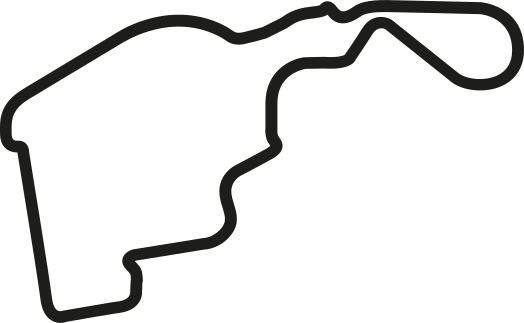



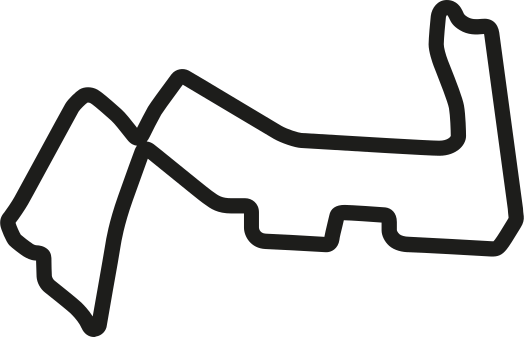









The Malaysian Grand Prix became one of Formula One’s most recognisable events of the modern era. Held at the Sepang International Circuit from 1999 to 2017, the race was famous for intense tropical heat, sudden monsoon downpours, and a flowing circuit layout that encouraged overtaking.
Sepang was built as part of Malaysia’s ambitious infrastructure projects in the late 1990s and quickly established itself as a fan favourite. With its wide track, sweeping corners, and long straights, it often produced dramatic races and unexpected results. Here is a look at every Formula One winner at Sepang.
What To Know?
- Michael Schumacher holds the record for most Malaysian Grand Prix wins with three victories at Sepang (2000, 2001, 2004).
- Four drivers won their first Formula One race in Malaysia: Kimi Räikkönen (2003), along with early career breakthroughs for several future champions who won there.
- The 2009 race remains one of the rare half-points Grands Prix after torrential rain forced the race to be stopped before 75 percent distance.
- Sepang produced several major championship moments, including Fernando Alonso’s remarkable wet-weather victory in 2012 and the infamous “Multi-21” incident between Sebastian Vettel and Mark Webber in 2013.
List of Every Malaysian Grand Prix Winner
| Year | Circuit | Driver | Constructor | Start Pos. | Win margin | Race time |
|---|---|---|---|---|---|---|
| 2017 | Sepang | Max Verstappen | Red Bull TAG Heuer | 3 | 12.770s | 1hr 30m 01.290s |
| 2016 | Sepang | Daniel Ricciardo | Red Bull TAG Heuer | 4 | 2.443s | 1hr 37m 12.776s |
| 2015 | Sepang | Sebastian Vettel | Ferrari | 2 | 8.569s | 1hr 41m 05.793s |
| 2014 | Sepang | Lewis Hamilton | Mercedes | 1 | 17.313s | 1hr 40m 25.974s |
| 2013 | Sepang | Sebastian Vettel | Red Bull Renault | 1 | 4.298s | 1hr 38m 56.681s |
| 2012 | Sepang | Fernando Alonso | Ferrari | 8 | 2.264s | 2hr 44m 51.812s |
| 2011 | Sepang | Sebastian Vettel | Red Bull Renault | 1 | 3.261s | 1hr 37m 39.832s |
| 2010 | Sepang | Sebastian Vettel | Red Bull Renault | 3 | 4.849s | 1hr 33m 48.412s |
| 2009 | Sepang | Jenson Button | Brawn GP Mercedes | 1 | 22.722s | 55m 30.622s |
| 2008 | Sepang | Kimi Raikkonen | Ferrari | 2 | 19.570s | 1hr 31m 18.555s |
| 2007 | Sepang | Fernando Alonso | McLaren Mercedes | 2 | 17.557s | 1hr 32m 14.930s |
| 2006 | Sepang | Giancarlo Fisichella | Renault | 1 | 4.585s | 1hr 30m 40.529s |
| 2005 | Sepang | Fernando Alonso | Renault | 1 | 24.327s | 1hr 31m 33.736s |
| 2004 | Sepang | Michael Schumacher | Ferrari | 1 | 5.022s | 1hr 31m 07.490s |
| 2003 | Sepang | Kimi Raikkonen | McLaren Mercedes | 7 | 39.286s | 1hr 32m 22.195s |
| 2002 | Sepang | Ralf Schumacher | Williams BMW | 4 | 39.699s | 1hr 34m 12.912s |
| 2001 | Sepang | Michael Schumacher | Ferrari | 1 | 23.660s | 1hr 47m 34.801s |
| 2000 | Sepang | Michael Schumacher | Ferrari | 1 | 0.732s | 1hr 35m 54.235s |
| 1999 | Sepang | Eddie Irvine | Ferrari | 2 | 1.040s | 1hr 36m 38.494s |
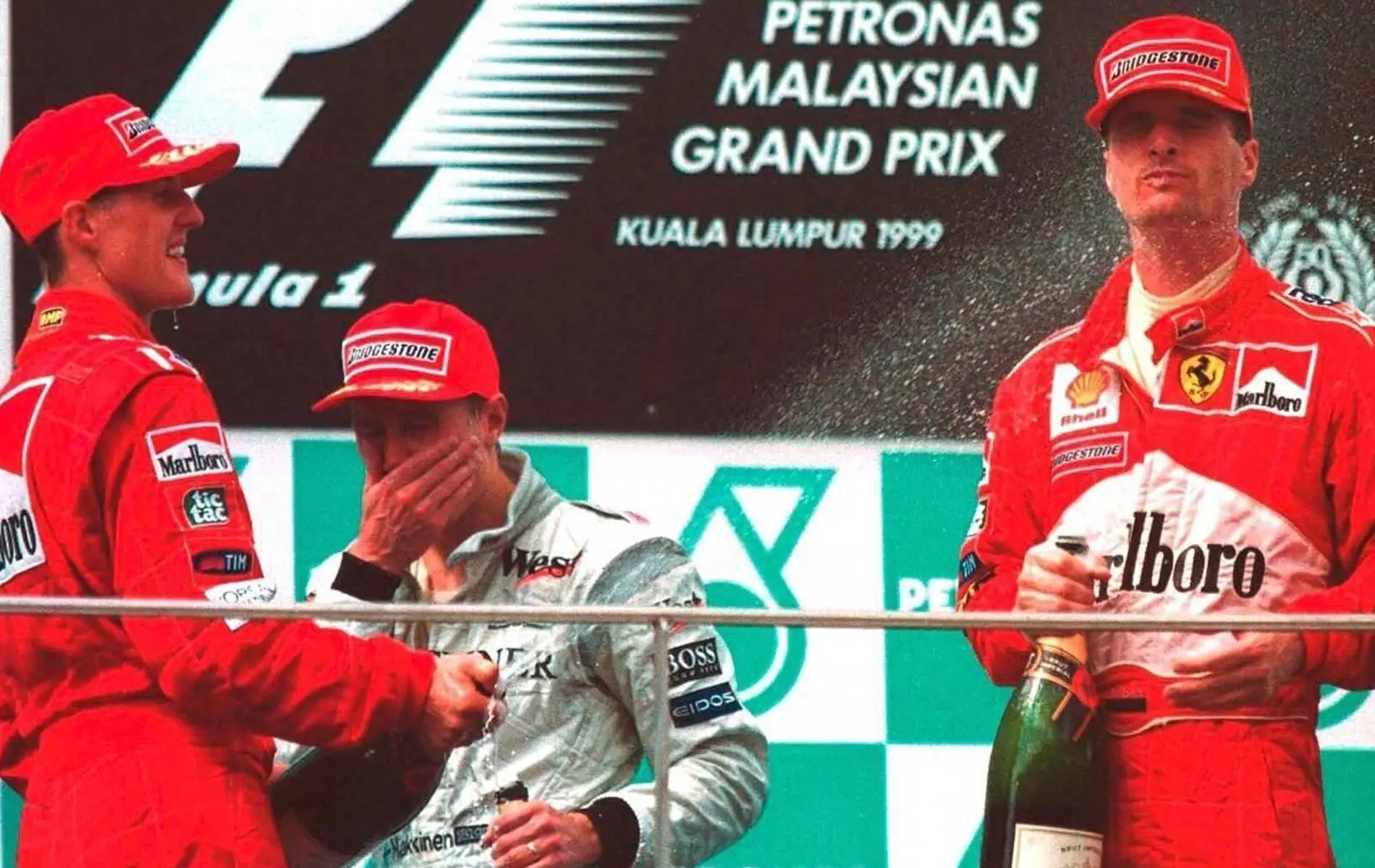
Malaysian Grand Prix Winners: 1999 to 2008
The first Formula One Malaysian Grand Prix in 1999 was won by Eddie Irvine for Ferrari. Michael Schumacher had returned from injury that weekend and dominated the race, but Ferrari’s strategy prioritised Irvine’s championship challenge. Schumacher allowed his teammate through to secure the victory, which briefly appeared in jeopardy when both Ferraris were disqualified for a technical irregularity, only to be reinstated on appeal.
In 2000, Michael Schumacher claimed victory for Ferrari during a season that would end Ferrari’s long wait for a driver’s championship. Starting from pole position, Schumacher controlled the race and added another win to a campaign that ultimately delivered his first title with the team.
The 2001 race became one of Sepang’s most memorable events because of torrential rain. Both Ferraris spun off the track in the downpour, yet remarkably recovered. Once the circuit began to dry, their pace proved superior to the rest of the field, and Michael Schumacher eventually led home a Ferrari 1-2 finish.
See also…
The 2002 Malaysian Grand Prix produced a surprise winner as Ralf Schumacher triumphed for Williams. A chaotic first lap eliminated several leading contenders, including his brother Michael. Ralf Schumacher avoided trouble and capitalised on the opportunity to deliver a convincing victory for Williams.
The 2003 race marked a significant milestone in F1 history as Kimi Räikkönen secured his first Grand Prix victory for McLaren. Starting from seventh on the grid, Räikkönen moved through the field and managed the race with impressive composure to claim his maiden win.
In 2004, Michael Schumacher returned to the top step with a commanding performance for Ferrari. Driving the dominant Ferrari F2004, Schumacher controlled the race from pole position during one of the most dominant seasons in Formula One history.
The 2005 Malaysian Grand Prix was won by Fernando Alonso for Renault. Starting from pole, Alonso delivered a dominant performance, helping establish Renault as the team to beat that season. In 2006, Giancarlo Fisichella secured Renault’s victory again. Starting from pole, Fisichella controlled the race and delivered a composed drive that reinforced Renault’s strong hold on the championship in that era.
The 2007 race marked the first victory for Fernando Alonso with McLaren. Alonso started second and quickly took the lead, ultimately guiding McLaren to a dominant one-two finish ahead of rookie Lewis Hamilton.
The final race in this period saw Kimi Räikkönen return to the top step in 2008 with a convincing victory for Ferrari.
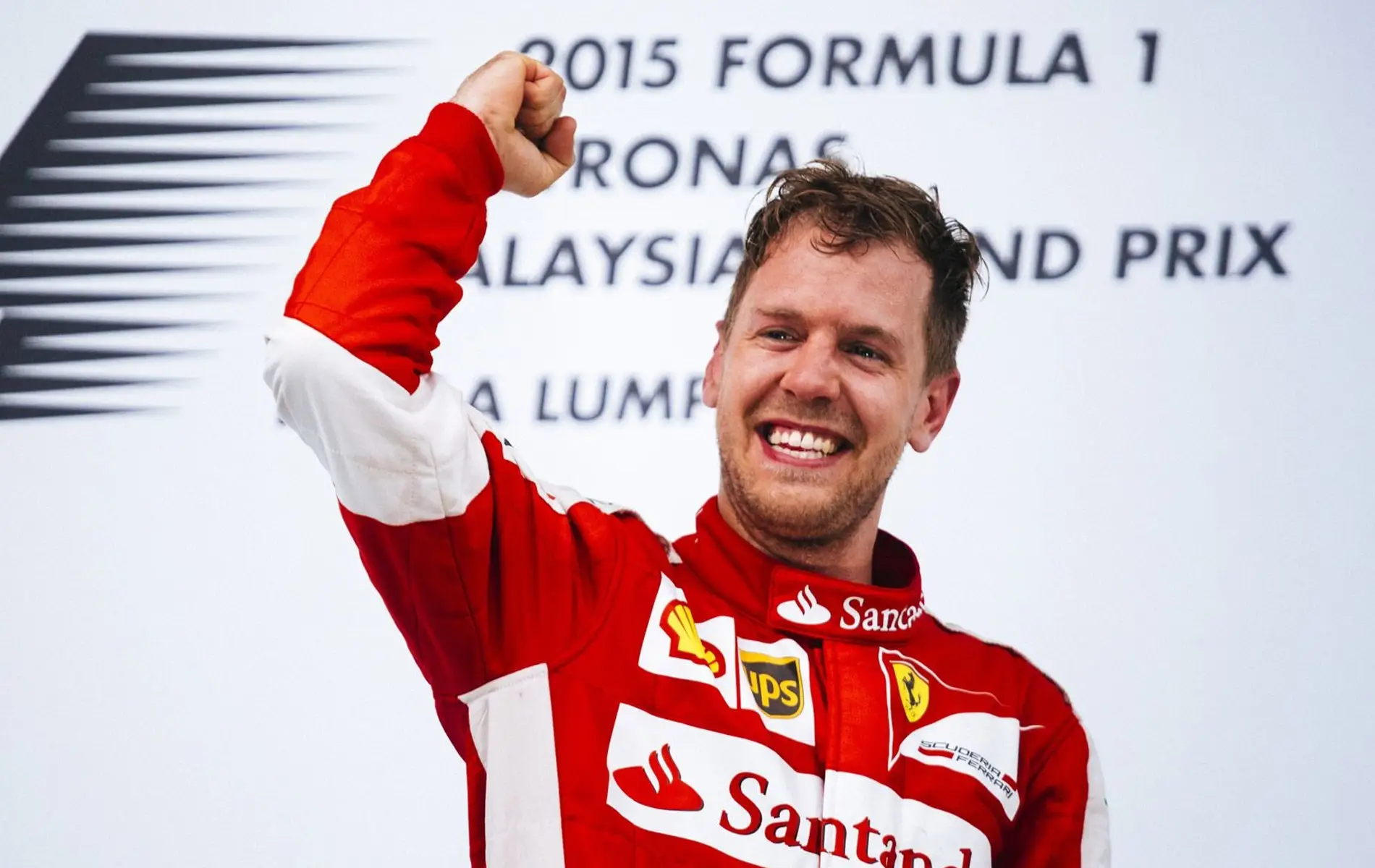
Malaysian Grand Prix Winners: 2009 to 2017
The 2009 Malaysian Grand Prix was dramatically affected by tropical rainstorms. Jenson Button led the race for Brawn GP before conditions deteriorated to the point that the race was red-flagged and never restarted. As less than 75 percent of the scheduled distance had been completed, only half points were awarded.
See also…
In 2010, Sebastian Vettel secured victory for Red Bull Racing. Starting from third on the grid, Vettel moved into the lead and delivered a confident performance during the early stages of Red Bull’s championship-winning era. Vettel repeated the feat in 2011, this time starting from pole position and controlling the race from the front to secure another win for Red Bull.
The 2012 Malaysian Grand Prix produced one of the standout drives of Fernando Alonso’s career. Starting eighth on the grid, Alonso navigated extremely wet conditions to take victory for Ferrari while holding off intense pressure from Sergio Pérez.
The 2013 race became famous for the controversial Multi-21 team orders incident. Sebastian Vettel ignored instructions to hold position and overtook team mate Mark Webber to claim victory for Red Bull Racing.
In 2014, Lewis Hamilton dominated the race for Mercedes. Starting from pole position, Hamilton controlled the event as Mercedes established its dominance in the hybrid era. The 2015 Malaysian Grand Prix saw Sebastian Vettel claim his first victory for Ferrari. Using strong tyre management and strategy, Vettel managed to defeat the dominant Mercedes cars.
In 2016, Daniel Ricciardo secured victory for Red Bull Racing after Lewis Hamilton suffered a dramatic engine failure while leading comfortably.
The final Malaysian Grand Prix in 2017 was won by Max Verstappen for Red Bull Racing. Verstappen overtook Lewis Hamilton early in the race and controlled the event to take victory on his 20th birthday, bringing Formula One’s era at Sepang to a memorable close.
More F1 Race Winners
From Adelaide to Silverstone to Monza and Spa, we chart the full story of every F1 winner from each event’s first race to the last.
Seen in: