





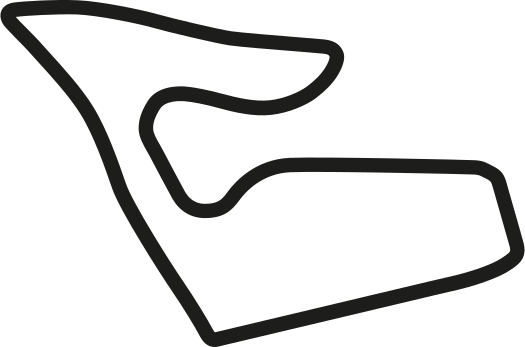

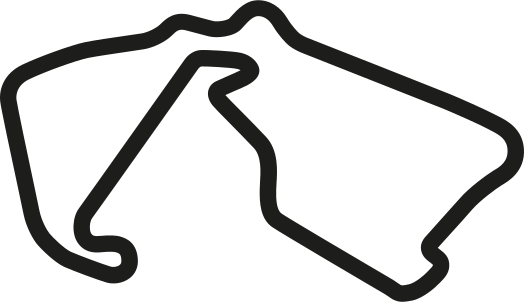

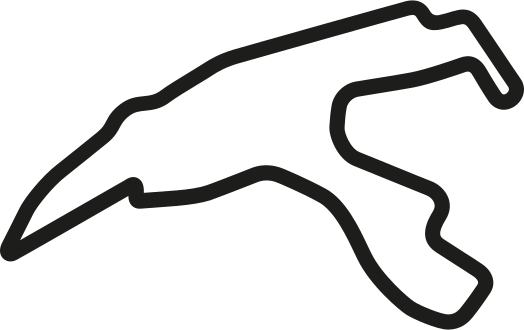

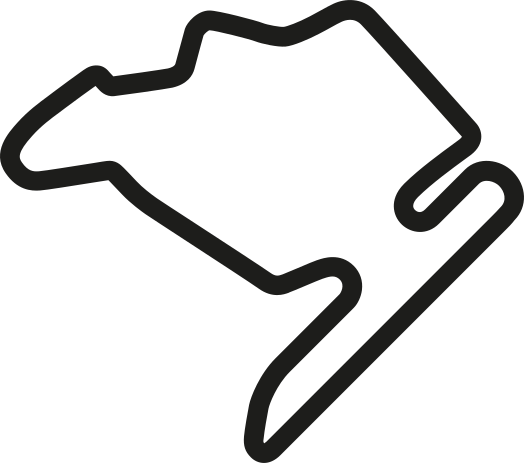














The 2008 FIA Formula One World Championship marked the 59th running of the championship, unfolding across 18 races from 16 March to 2 November. The title fight delivered one of the most dramatic finales in F1 history. Lewis Hamilton secured the Drivers’ Championship by the slimmest possible margin, just a single point, in a breathtaking conclusion at the Brazilian Grand Prix.
Season
Two major additions reshaped the calendar that year. The inaugural Singapore Grand Prix debuted on the streets of Marina Bay, becoming Formula One’s first-ever night race under floodlights, a spectacular new chapter for the sport. Meanwhile, the European Grand Prix moved to a brand-new temporary street circuit through the harbour district of Valencia in Spain, bringing another striking urban backdrop to the championship.
The title fight delivered one of the most dramatic finales in Formula One history. Lewis Hamilton secured the Drivers’ Championship by the slimmest possible margin — just a single point — in a breathtaking conclusion at the Brazilian Grand Prix. Heading into the final lap at Interlagos, Hamilton needed to finish fifth to clinch the crown but was running sixth behind Toyota’s Timo Glock. As rain intensified in the closing moments, Hamilton seized his opportunity and overtook Glock at the very last corner of the final lap. The move lifted him into the crucial fifth place required to claim the championship.
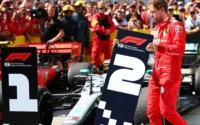
Moments earlier, Ferrari’s Felipe Massa had crossed the finish line to win his home race, and celebrations had already begun in the Ferrari garage and among Massa’s family, believing the title had been secured. Hamilton’s last-corner pass instantly reversed the outcome, sealing the championship in one of the most unforgettable finishes the sport has ever witnessed.
Massa ultimately finished second in the standings after a superb campaign, while his Ferrari teammate and reigning world champion Kimi Räikkönen placed third overall. Räikkönen collected two victories during the year — in Malaysia and Spain — but a mid-season slump prevented him from mounting a sustained title defence. Ferrari nonetheless celebrated success by securing the 2008 Constructors’ Championship.
Hamilton’s triumph carried historic significance. At the time, he became the youngest driver ever to win the Formula One World Championship — a record later broken by Sebastian Vettel in 2010. Hamilton also became the first Black driver to win the title and the first British champion since Damon Hill in 1996.
The season featured eleven teams, although the grid was reduced partway through the year when Super Aguri withdrew from the championship on 6 May due to financial difficulties after competing in the first four races.
On the technical front, 2008 saw the return of a major regulation change: traction control was banned, ending its use in Formula One after it had been reintroduced in 2001. The removal of electronic driver aids was intended to place greater emphasis back on driver skill.
One of the most controversial moments in Formula One history also emerged from this season. The inaugural Singapore Grand Prix was won by Fernando Alonso, but the victory was later overshadowed by revelations that teammate Nelson Piquet Jr. had deliberately crashed during the race to trigger a Safety Car period, dramatically benefiting Alonso’s strategy. When Piquet admitted the scheme publicly in 2009, Renault team principal Flavio Briatore resigned amid the fallout. The scandal quickly became known in the media as “Crashgate.”
The 2008 campaign also marked the end of an era for several teams and drivers. Honda competed in its final season before withdrawing from Formula One later that year due to the global financial crisis. The team was subsequently purchased by Ross Brawn and relaunched as Brawn GP for the 2009 season, powered by Mercedes-Benz engines. Honda would eventually return to the sport as an engine supplier from 2015 to 2021.
Tyre regulations also reached the end of a long chapter. The 2008 season was the final year in which Formula One cars raced on grooved tyres, a format that had been in place since 1998 to reduce cornering speeds. From 2009 onward, the sport returned to slick tyres, restoring the full contact patch and increasing mechanical grip.
Veteran driver David Coulthard also brought his Formula One career to a close at the end of the season. After 14 years in the sport and 246 race starts — including 13 Grand Prix victories — the Scot retired from racing and moved into a broadcasting role with the BBC beginning in 2009.
The year was notable for its unusual driver continuity. For the first time in Formula 1 history, every team used the same two drivers for the entire season, with no mid-season driver substitutions — a rarity in the sport. It was also the only season in which two Finnish drivers won races: Räikkönen triumphed in Malaysia and Spain, while Heikki Kovalainen secured his maiden victory at the Hungarian Grand Prix.
Regulation Changes
The 2008 season introduced a series of important technical and sporting rule adjustments aimed at reducing costs, improving safety, and shifting greater emphasis back onto driver skill. One of the most significant changes involved the introduction of a standard Electronic Control Unit (ECU) supplied by Microsoft MES, a joint venture between Microsoft and McLaren Electronic Systems. By standardising the ECU across all teams, the FIA aimed to prevent the development of sophisticated electronic driver aids and ensure a more level technological playing field.
As part of this shift, traction control was banned for the 2008 season, along with systems designed to reduce engine braking. The removal of these electronic aids marked a deliberate effort to increase the influence of driver input and mechanical control, returning a greater degree of responsibility to the drivers themselves.
Another major measure was the introduction of an engine freeze, intended to last for five years. This rule prevented teams from making significant performance-related changes to their engines, helping to control development costs across the sport. In addition, a small but notable adjustment was made to the engine penalty system: the first unscheduled engine change of the season would not automatically incur the traditional ten-place grid penalty, giving teams slightly more flexibility early in the year.
Environmental considerations also became part of the technical regulations. The fuel used by Formula One cars in 2008 was required to contain at least 5.75% biological components, reflecting a growing push within the sport to incorporate more sustainable technologies.
Durability requirements were also extended to gearboxes. Teams were now required to ensure that each gearbox lasted four consecutive races, and a driver would receive a five-place grid penalty if the unit needed to be replaced before that limit. However, if a driver failed to finish a race, the gearbox could be changed for the following event without a penalty.
Safety improvements were introduced as well. Cockpit protection was enhanced, part of the FIA’s ongoing efforts to strengthen driver safety following several high-profile accidents in previous seasons.
Another logistical regulation concerned the use of spare cars. Teams were no longer permitted to maintain a fully prepared third car for use during race weekends. Instead, each team was limited to having no more than two cars available for use at any given time. For the purposes of this rule, a car was considered complete if it consisted of a partially assembled survival cell fitted with an engine along with major components such as the front suspension, bodywork, radiators, oil tanks, or heat exchangers.
Tyres continued to be supplied exclusively by Bridgestone, which served as the championship’s sole tyre manufacturer. The company’s agreement covered the 2008 to 2010 seasons, and to help teams distinguish between wet tyre compounds, Bridgestone introduced a white line in the central groove of the extreme wet-weather tyres, allowing them to be easily differentiated from the softer intermediate wet tyres.
Testing was also restricted in order to control costs. Teams were limited to a maximum of 30,000 kilometres (18,641 miles) of testing during the 2008 calendar year, significantly reducing the amount of private track running teams could undertake outside race weekends.
Qualifying Changes
The qualifying format also received several adjustments for the 2008 season. The first segment of qualifying, Q1, was extended to 20 minutes, while the final segment, Q3, was shortened to 10 minutes. A further change was introduced to eliminate the strategic “fuel-burn” phase that had previously taken place at the end of qualifying sessions. Teams participating in Q3 were no longer permitted to add fuel to their cars after qualifying, meaning the fuel level used during the session would directly determine their starting fuel load for the race.
From the third round of the championship in Bahrain, the FIA also implemented a minimum lap-time requirement for qualifying sessions. This rule was introduced after incidents at the Malaysian Grand Prix, in which drivers slowed excessively while returning to the pits, creating dangerous speed differentials on track. The stewards had already penalised Lewis Hamilton and Heikki Kovalainen with five-place grid drops after ruling that they had impeded Nick Heidfeld and Fernando Alonso during qualifying in Malaysia. To prevent similar situations, a minimum lap time was introduced for each race — for example, it was set at 1 minute 39 seconds in Bahrain — ensuring that drivers could not circulate at dangerously slow speeds.
The qualifying structure itself also changed during the season. On 8 May 2008, following Super Aguri’s withdrawal from the championship, the FIA adjusted the elimination format to reflect the smaller grid. Instead of six drivers being eliminated at the end of Q1, only the five slowest drivers would be knocked out, increasing the chances that a midfield team might miss the cut. The same principle applied in Q2, where five drivers rather than six were eliminated before the final shootout in Q3. This ensured that 15 drivers pro
2008 F1 Entries Drivers and Teams
The teams and drivers listed below competed in the 2008 FIA Formula One World Championship. Car numbers are shown exactly as they appeared on the official FIA 2008 entry list. Team information follows the Formula 1 official website unless otherwise stated. In keeping with long-standing Formula One tradition, car number 13 was not allocated.
| Entrant | Constructor | Chassis | Engine | No. | Race drivers | Rounds |
|---|---|---|---|---|---|---|
| Scuderia Ferrari | Ferrari | F2008 | Ferrari 056 2008 | 1 | Kimi Räikkönen | All |
| 2 | Felipe Massa | All | ||||
| BMW Sauber F1 Team | BMW Sauber | F1.08 | BMW P86/8 | 3 | Nick Heidfeld | All |
| 4 | Robert Kubica | All | ||||
| ING Renault F1 Team | Renault | R28 | Renault RS27 | 5 | Fernando Alonso | All |
| 6 | Nelson Piquet Jr. | All | ||||
| AT&T Williams | Williams-Toyota | FW30 | Toyota RVX-08 | 7 | Nico Rosberg | All |
| 8 | Kazuki Nakajima | All | ||||
| Red Bull Racing | Red Bull-Renault | RB4 | Renault RS27 | 9 | David Coulthard | All |
| 10 | Mark Webber | All | ||||
| Panasonic Toyota Racing | Toyota | TF108 | Toyota RVX-08 | 11 | Jarno Trulli | All |
| 12 | Timo Glock | All | ||||
| Scuderia Toro Rosso | Toro Rosso-Ferrari | STR2B STR3 | Ferrari 056 2007 | 14 | Sébastien Bourdais | All |
| 15 | Sebastian Vettel | All | ||||
| Honda Racing F1 Team | Honda | RA108 | Honda RA808E | 16 | Jenson Button | All |
| 17 | Rubens Barrichello | All | ||||
| Super Aguri F1 Team | Super Aguri-Honda | SA08 | Honda RA808E | 18 | Takuma Sato | 1–4 |
| 19 | Anthony Davidson | 1–4 | ||||
| Force India F1 Team | Force India-Ferrari | VJM01 | Ferrari 056 2007 | 20 | Adrian Sutil | All |
| 21 | Giancarlo Fisichella | All | ||||
| Vodafone McLaren Mercedes | McLaren-Mercedes | MP4-23 | Mercedes FO108V | 22 | Lewis Hamilton | All |
| 23 | Heikki Kovalainen | All |
New Entries
Planning for the 2008 Formula One season began well in advance when FIA president Max Mosley announced on 14 February 2006 that any organisation interested in joining the championship would be given a strict seven-day window to submit an application. The announcement triggered considerable interest throughout the motorsport world. All eleven teams already competing in Formula One applied to remain on the grid, but they were joined by several ambitious new organisations hoping to enter the sport.
By the time the application process closed, the FIA had received twenty-one bids in total. Alongside the established teams were prospective entrants such as European Minardi F1 Team Ltd, Jordan Grand Prix, Direxiv, and Carlin Motorsport, all eager to secure a place in Formula One. Despite the strong interest, the FIA had already made it clear that the championship grid would be limited to twelve teams, meaning that only one new entrant could ultimately be accepted.
On 28 April 2006, the FIA announced its decision. All eleven existing teams were granted entry to the 2008 championship, while the final available slot was awarded to Prodrive, a motorsport and technology company led by experienced team principal David Richards, who had previously managed Formula One teams at BAR and Benetton. The governing body confirmed that Prodrive had demonstrated sufficient financial backing to support its entry and that Richards’ experience within the sport had strengthened the team’s application.
However, although Prodrive had been officially granted a place on the grid, the team ultimately did not compete. Throughout 2007, the project became caught in a dispute regarding the legality of customer cars — the practice of one team running a chassis designed by another. Negotiations between Richards and the FIA failed to reach a timely resolution, and as the 2008 season approached, the unresolved legal situation left insufficient time to build and prepare a competitive car. On 23 November 2007, Richards announced that Prodrive F1 would not participate in the 2008 Formula One World Championship, meaning the expected twelfth team never appeared and the grid remained unchanged.
Team Changes
While the number of teams remained stable at the start of the season, one team underwent a significant transformation. During the closing months of the 2007 season, rumours circulated widely in the Formula One paddock that Spyker might soon be sold. The Dutch manufacturer had only purchased the team from Midland the previous year, but financial and strategic considerations soon led to another change in ownership.
In late 2007, the team was acquired by Indian businessman Vijay Mallya for approximately €88 million, several million more than Spyker had paid when it bought the operation. The purchase marked an important moment for the sport, as Mallya intended to establish a team representing India on the Formula One grid.
On 24 October 2007, the FIA approved a request to rename the team, and the outfit officially became Force India. Early in 2008, the team held a formal launch event to reveal its driver line-up for the upcoming season. Veteran Italian driver Giancarlo Fisichella was confirmed as the team’s lead driver, bringing with him years of Formula One experience and multiple Grand Prix victories. He was joined by Adrian Sutil, who stepped into the second race seat, while Vitantonio Liuzzi was appointed as the team’s test and reserve driver.
However, the 2008 season would also see a team depart the grid. Super Aguri, which had joined Formula One in 2006, entered the year facing severe financial challenges after failing to receive payment linked to a sponsorship agreement at the end of 2007. The team explored several options to remain viable, including discussions with potential investors.
In January 2008, Super Aguri declined a proposed buyout from an Indian consortium led by the CEO of the Spice Group. The deal came with a condition that Indian driver Narain Karthikeyan would join the race line-up, which would have required the team to replace or demote one of its existing drivers from the 2007 season. The team ultimately rejected the proposal.
Without stable financial backing, Super Aguri struggled to secure sponsorships and partnerships, although it continued to prepare for the season. On 10 March, the team confirmed that Takuma Sato and Anthony Davidson would remain as its race drivers. Hopes of rescuing the team were briefly raised when Super Aguri announced that it had reached a major agreement with the Magma Group, which appeared capable of resolving the team’s financial difficulties.
Unfortunately, the deal collapsed before it could be finalised. With no alternative funding available, the team’s situation became unsustainable. On 6 May 2008, Super Aguri officially withdrew from the Formula One World Championship, reducing the number of competitors on the grid. The team’s collapse also fulfilled an earlier prediction made by Max Mosley at the start of the season that the struggling outfit might not survive until the final race in Brazil.
Driver Changes
The winter leading into the 2008 season also saw a number of significant driver moves across the paddock. One of the most notable departures was Fernando Alonso‘s from McLaren after just one turbulent season with the team. The two-time world champion returned to Renault, the outfit with which he had secured both of his previous titles in 2005 and 2006.
Alonso’s exit created an opening at McLaren, which was filled by Heikki Kovalainen. The Finnish driver moved across from Renault, effectively swapping places with Alonso after having spent the previous season racing for the French team.
Renault’s driver line-up therefore changed further. Giancarlo Fisichella, who had partnered Alonso in 2007, left the team to join the newly renamed Force India, replacing former Spyker driver Sakon Yamamoto, who moved into a test and development role with Renault. Fisichella’s departure created an opportunity for the team’s test driver Nelson Piquet Jr., who was promoted to a full-time race seat. Piquet Jr. carried a famous name into Formula One, being the son of three-time World Champion Nelson Piquet.
Another experienced driver leaving the grid was Ralf Schumacher. After spending ten seasons in Formula One, the German driver parted ways with Toyota following an unsuccessful test session with Force India in December 2007. Schumacher subsequently moved to the DTM touring car championship, signing with Mücke Motorsport.
His departure opened a race seat at Toyota, which was filled by Timo Glock, the reigning 2007 GP2 Series champion. Glock had previously served as a test driver for BMW Sauber, and his promotion marked his return to a full-time Formula One race drive.
BMW Sauber also adjusted its driver development programme. Former Honda test driver Christian Klien joined the team in a reserve role, while Marko Asmer of Estonia was also recruited as a test driver to assist with the team’s development work.
Elsewhere, Scuderia Toro Rosso introduced a new driver in the form of Sébastien Bourdais. The Frenchman entered Formula One after dominating the Champ Car World Series, where he had won four consecutive championships, including the 2007 title. Bourdais replaced Vitantonio Liuzzi, who departed Toro Rosso and later joined Force India as their test driver.
These team reshuffles and driver movements reshaped the competitive landscape heading into the 2008 season, setting the stage for a championship that would ultimately produce one of the most dramatic title battles in Formula One history.
2008 Formula 1 Race Calendar
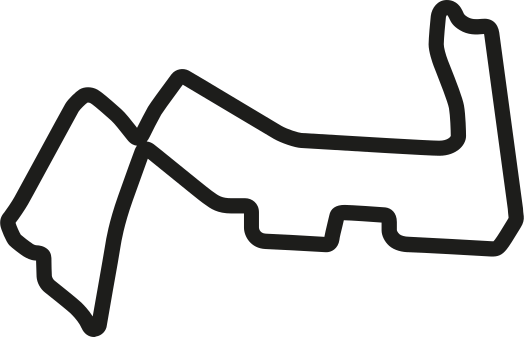
The 2008 Formula One calendar introduced several notable adjustments, including the arrival of a brand-new venue and the relocation of an established event. One of the most significant additions was the Singapore Grand Prix, which joined the championship schedule for the first time under a five-year agreement. The race was held on the Marina Bay Street Circuit, a challenging temporary track designed by engineering firm KBR that winds its way through the heart of Singapore’s Marina Bay district. Running anticlockwise and featuring 23 corners, the circuit placed the pit lane between turns 22 and 2. Most famously, the race was staged under floodlights, making it Formula One’s first-ever night race. To maintain consistent conditions for teams and drivers, both the practice sessions and qualifying were also held at night.
Another major change involved the European Grand Prix, which moved from the Nürburgring to a new street circuit in Valencia, Spain for the 2008 season. The Valencia Street Circuit ran through the city’s harbour area and introduced a fresh urban setting for the event. Because the Nürburgring and Hockenheimring shared the right to host a Formula One race in Germany, the German Grand Prix itself was staged at Hockenheim in 2008. This arrangement continued a rotation system between the two circuits that would remain in place until 2014.
One venue absent from the calendar was the Indianapolis Motor Speedway, which had hosted the United States Grand Prix between 2000 and 2007. Although no race was scheduled there in 2008, the possibility of a future return was not entirely ruled out at the time. Formula One would eventually return to the United States in 2012, albeit at a different location, with the creation of the Circuit of the Americas in Austin, Texas.
The future of the French Grand Prix was also uncertain during this period. In the build-up to the 2007 race, reports suggested that the event held at Magny-Cours might be its final appearance on the Formula One calendar. Several alternative venues were discussed as possible replacements, including the Paul Ricard Circuit, as well as proposals for a completely new track near Disneyland Paris or close to Charles de Gaulle Airport. However, on 24 July 2007, Formula One commercial chief Bernie Ecclestone announced that he had “agreed in principle” to keep the race at Magny-Cours for the 2008 season — and potentially for 2009 as well — provided that no viable alternative venues emerged.
2008 Formula 1 Race Reports
Round 1: Australian Grand Prix
Race date: 16 March
Circuit: Albert Park Circuit , Melbourne
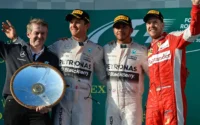
The season-opening 2008 Australian Grand Prix attracted 200,000 fans and celebrated Rubens Barrichello‘s 250th Grand Prix start. However, it was a disappointing day for him after he was disqualified for ignoring a red light at the pit-lane exit. Lewis Hamilton, who started on pole in his McLaren–Mercedes, won the race, setting the stage for his eventual Drivers’ Championship victory that year.
Nick Heidfeld secured second for Sauber, and Nico Rosberg third in a Williams. This was Rosberg’s first F1 podium finish. The race was also the first time in seven years, since the 2001 San Marino Grand Prix, not to feature cars using traction control, which the FIA had banned at the end of 2007.
Round 2: Malaysian Grand Prix
Race date: 23 March
Circuit: Sepang International Circuit
The 2008 Malaysian Grand Prix was won by Kimi Raikkonen of Ferrari, who started from second position. Robert Kubica took second place in his BMW Sauber, with Heikki Kovalainen finishing third for McLaren.
The race began with an all-Ferrari front row, as Felipe Massa claimed pole position with Räikkönen beside him. Initially, McLaren’s Heikki Kovalainen and Lewis Hamilton were set to start just behind on the second row, but both received five-place grid penalties for impeding Nick Heidfeld and Fernando Alonso during qualifying, which pushed them back to eighth and ninth. Despite finishing in fifth, Lewis Hamilton retained his lead in the Drivers’ Championship with 14 points, a championship he would eventually win.
Round 3: Bahrain Grand Prix
Race date: 6 April
Circuit: Bahrain International Circuit, Sakhir
The 2008 Bahrain Grand Prix was overshadowed by tabloid allegations about Max Mosley, which surfaced the week before. Facing intense media scrutiny and pressure from several teams calling for his resignation, Mosley cancelled his planned visit. On track, the race itself was uneventful, with the Ferrari of Felipe Massa taking a straightforward victory. Kimi Räikkönen was second in the other Ferrari, and BMW Sauber driver Robert Kubica was third.
Championship leader Lewis Hamilton endured a difficult day—stalling on the grid due to a launch control mapping error before colliding with previous season teammate Fernando Alonso (now back with Renault). After a pit stop for a new front wing, he rejoined in 18th place and could only recover to finish 13th.
Round 4: Spanish Grand Prix
Race date: 27 April
Circuit: Circuit de Catalunya , Montmeló
Defending champion Kimi Raikkonen extended his championship lead with a dominant victory at the 2008 Spanish Grand Prix, leading a Ferrari 1-2 ahead of Felipe Massa. However, this would prove to be Räikkönen’s final win of the season, as he struggled to adapt to the new Bridgestone tyres and eventually fell 23 points short of 2008 title winner Lewis Hamilton, who came third in the race.
The race itself was largely processional, with few overtaking opportunities. However, it was punctuated by a frightening crash when Heikki Kovalainen lost control of his McLaren and slammed deep into the tyre barrier at high speed. The rescue operation took several minutes, but Kovalainen fortunately emerged unscathed.
Formula One History Recommends
Round 5: Turkish Grand Prix
Race date: 11 May
Circuit: Istanbul Park, Istanbul
Felipe Massa clinched victory on May 11 at the 2008 Turkish Grand Prix, successfully countering the McLaren of Lewis Hamilton and their aggressive three-stop strategy. Despite Hamilton temporarily taking the lead, Ferrari maintained control, with Massa securing one of his six wins of the 2008 season. He would narrowly miss being crowned champion, finishing just one point behind Hamilton in Brazil. Kimi Raikkonen was third in the second Ferrari.
Round 6: Monaco Grand Prix
Race date: 25 May
Circuit: Circuit de Monaco , Monte Carlo
McLaren driver Lewis Hamilton staged a remarkable comeback to win the 2008 Monaco Grand Prix, finishing ahead of BMW Sauber driver Robert Kubica and the Ferrari of Felipe Massa. After hitting a barrier early on, Hamilton had to pit to replace a tyre, but he fought back impressively through the field. His efforts were aided significantly by a safety car, and a drive-through penalty for Kimi Raikkonen, and Felipe Massa running wide on an escape road. Despite these advantages, Hamilton’s exceptional skill in wet conditions was a decisive factor. He was the first English driver to win at Monaco since Graham Hill in 1969.
Round 7: Canadian Grand Prix
Race date: 8 June
Circuit: Circuit Gilles Villeneuve , Montreal
At the 2008 Canadian Grand Prix, Lewis Hamilton was well on his way to another win, leading the race by 7.1 seconds until a shocking error. During a pit stop initiated by a safety car period caused by Adrian Sutil’s car stopping on track, Hamilton collided with a stationary Kimi Raikkonen in the Ferrari in the pit lane. Nico Rosberg followed suit, crashing into Hamilton. This sequence of events led Robert Kubica to achieve his first Formula One victory and the first for the BMW Sauber team, with Nick Heidfeld securing second place to complete a 1-2 finish for the team.
Formula One History Recommends
Round 8: French Grand Prix
Race date: 22 June
Circuit: Circuit de Nevers Magny-Cours, Magny-Cours
Felipe Massa triumphed for Ferrari at the 2008 French Grand Prix. Kimi Raikkonen in the sister Ferrari was poised for victory, but a malfunctioning exhaust forced him to slow down, and he ultimately finished second. Jarno Trulli, driving for Toyota, completed the podium in third.
The 2008 race was the last French Grand Prix for ten years and the last at Magny-Cours, with its return in 2018 at Circuit Paul Ricard.
Round 9: British Grand Prix
Race date: 6 July
Circuit: Silverstone Circuit , Silverstone
Lewis Hamilton won the 2008 British Grand Prix by well over a minute in torrential rain at Silverstone. Despite the appalling conditions, Hamilton drove flawlessly, coming from fourth on the grid, overtaking his teammate Heikki Kovalainen for the lead, and pulling away from the field. Many drivers struggled, but none more so than Felipe Massa, who spun his Ferrari five times and finished 13th, two laps down. After securing his first F1 victory on home soil, Hamilton said: “When I came round the last time, I saw the crowd standing up and I prayed: ‘Just finish, just finish.’ It was a very emotional moment to win my home grand prix and I want to dedicate this victory to my family.”
Round 10: German Grand Prix
Race date: 20 July
Circuit: Hockenheimring, Hockenheim
Lewis Hamilton overcame a botched strategy to defeat world championship rival Felipe Massa in one of his standout performances during his first title-winning season. Hamilton initially controlled the 2008 German Grand Prix at Hockenheim until a severe accident involving Timo Glock in a Toyota brought out the safety car. While most drivers pitted as expected, Hamilton remained on track, later losing positions when he had to pit under racing conditions. Despite this setback, Hamilton showcased his skill with a remarkable overtaking display, recovering from fifth place to secure victory at the Hockenheim circuit.
Nelson Piquet Jr. finished second for Renault, with Massa third for Ferrari.
Round 11: Hungarian Grand Prix
Race date: 3 August
Circuit: Hungaroring , Mogyoród
Felipe Massa suffered a heartbreaking loss at the 2008 Hungarian Grand Prix when his Ferrari engine blew three laps from the finish, forcing him to coast to a halt on the pit straight. Massa, who had taken the lead from the first corner and maintained it throughout the race, saw his victory snatched away through no fault of his own. Heikki Kovalainen went on to claim his maiden race win for McLaren, which made him the sport’s 100th driver to win a World Championship race, while Lewis Hamilton secured his 10th career pole the previous day.
Timo Glock with Toyota came home in P2 and Finland’s Kimi Räikkönen with Ferrari in P3. As a consequence of the race, Hamilton extended his lead in the 2008 Drivers’ Championship to five points over Räikkönen, with Massa a further three behind. A title he would go on to win in dramatic fashion in Brazil.
Round 12: European Grand Prix
Race date: 24 August
Circuit: Valencia Street Circuit, Valencia
Valencia hosted its first-ever Grand Prix, where the Ferrari of Felipe Massa claimed victory in the 2008 European Grand Prix, finishing ahead of Lewis Hamilton and Robert Kubica. The race, held on a tight new street circuit, was relatively uneventful, with Massa maintaining control from start to finish. The most significant incident occurred when Kimi Raikkonen attempted to leave the pits before his car refuelling hose was detached, resulting in a team refueler, Pietro Timpini, being knocked over and suffering a foot fracture and back pain. Massa’s victory narrowed the gap in the championship standings to six points between him and leader Hamilton.
Round 13: Belgian Grand Prix
Race date: 7 September
Circuit: Circuit de Spa-Francorchamps, Stavelot
McLaren driver Lewis Hamilton was controversially stripped of victory at the 2008 Belgian Grand Prix after stewards ruled that he had gained an unfair advantage by passing Kimi Raikkonen in the Ferrari after cutting a chicane. Despite Hamilton giving back the position immediately after the manoeuvre, the stewards imposed a 25-second penalty, dropping him to third. “This is motor racing, and if there’s a penalty, then there’s something wrong,” Hamilton remarked as the stewards deliberated. “But you know what they are like.” Raikkonen later crashed out, allowing Felipe Massa to take the win for Ferrari, with Nick Heidfeld in a Sauber finishing second.
Round 14: Italian Grand Prix
Race date: 14 September
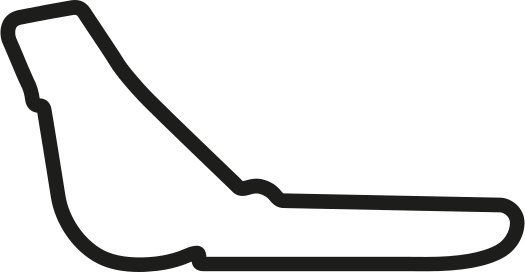
Circuit: Autodromo Nazionale di Monza , Monza
Sebastian Vettel became the youngest F1 driver at the time to win a Formula One Grand Prix at the 2008 Italian Grand Prix, aged 21 years and 74 days, driving for Toro Rosso. The day before, Vettel had also become the youngest driver at the time to take pole in Formula One history. He finished 12.5 seconds ahead of McLaren’s Heikki Kovalainen in wet weather conditions. The 21-year-old drove with precision in the slippery conditions while running standard-spec low downforce at the 3.6-mile circuit. In the post-race press conference, Vettel recalled the last few laps:
“P1 was still on the board, P1 and a plus, and I was leading by quite a bit, and I thought f***k, you know, if you finish the race you will be winning – I apologise – but you know, it was unbelievable. Then I tried to focus again, the conditions were difficult. In the end it was not so difficult to keep up concentration.”
The result was also a team best for Toro Rosso, being the only podium finish it ever achieved. The 2008 World Champion Lewis Hamilton only managed seventh.
Round 15: Singapore Grand Prix
Race date: 28 September
Circuit: Marina Bay Street Circuit, Singapore
Fernando Alonso‘s victory for Renault at the 2008 Singapore Grand Prix was hailed as a miracle after he started 15th in the first-ever night race. However, the race later became infamous as part of the “Crashgate” scandal. On the 14th lap, Alonso’s teammate, Nelson Piquet Jr., crashed, bringing out the safety car, which worked in Alonso’s favour. Ten months later, the true nature of Piquet’s intentional crash came to light. Meanwhile, race leader Felipe Massa’s Ferrari team suffered a disastrous pit stop, where Massa drove off with the fuel hose still attached, dropping him to last after a penalty. Nico Rosberg took second for Williams, and Lewis Hamilton third in a McLaren.
Round 16: Japanese Grand Prix
Race date: 12 October
Circuit: Fuji Speedway, Oyama, Shizuoka
There were accusations and recriminations in Fuji at the 2008 Japanese Grand Prix, where Lewis Hamilton accused Felipe Massa of deliberately crashing into him as the pair clashed for fifth place on the second lap.
The incident put Hamilton at the back of the field, cut his lead in the 2008 Drivers’ Championship over Massa to five points, and left him facing the possibility of blowing the title for the second year. “I did the corner normally, and he came back very aggressively and hit me,” Hamilton fumed. “I think that was pretty much as deliberate as can be.”
Massa was more diplomatic. “The duel with Hamilton was hard but fair … I have a good relationship with [him], and I will not do anything to destroy something on purpose.”
Fernando Alonso won the race in a Renault, with Robert Kubica in a BMW Sauber, finishing second, and Kimi Raikkonen in a Ferrari, completing the podium in third.
Round 17: Chinese Grand Prix
Race date: 19 October
Circuit: Shanghai International Circuit, Shanghai
Lewis Hamilton kept the championship battle alive with a victory with McLaren at the 2008 Chinese Grand Prix, ahead of his closest rival, Felipe Massa, who finished second for Ferrari. Heading into the final race in Brazil needing just four points to secure the title, Hamilton cautioned, “Remember last year? It’s not over until it’s over.” His words proved prophetic. The China race itself offered little excitement, with the only notable overtake among the frontrunners coming when Kimi Raikkonen handed second place to his Ferrari teammate, Massa, and settled for third. “It was pretty boring, even for us drivers,” Massa admitted.
Round 18: Brazilian Grand Prix
Race date: 2 November
Circuit: Autódromo José Carlos Pace , São Paulo
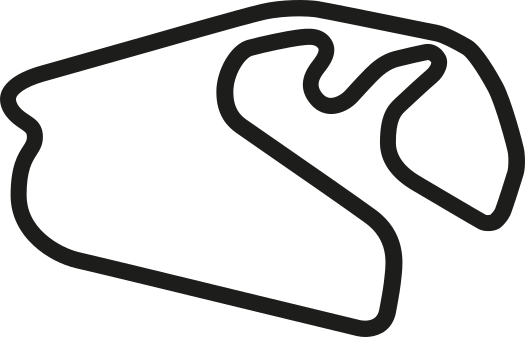
The 2008 Formula 1 season climaxed with a dramatic 2008 Brazilian Grand Prix. McLaren driver Lewis Hamilton captured the World Championship on the final lap, securing the fifth place he needed. With just two laps to go, Sebastian Vettel overtook Hamilton, dropping him to sixth, seemingly dashing his title hopes. Ferrari’s, Felipe Massa, leading the race, crossed the finish line first and was briefly celebrated by his Ferrari team as the new champion. Yet, within moments, the celebrations stopped—Timo Glock, struggling in his Toyota on dry-weather tyres in the rain, lost 18 seconds on the final lap. Just before the finish, Hamilton and Vettel both passed him, handing Hamilton the points he needed to clinch the title, leaving a stunned Massa just short of victory.
“My heart was in my mouth,” Hamilton later reflected. “I was almost exploding. I don’t know how I kept my cool. It was one of the toughest races of my life.” Massa was visibly devastated, confessing, “I don’t cry often, but today it was hard not to.”
Despite not winning the Drivers’, Massa’s efforts all season helped Ferrari to secure the 2008 Constructors’ Championship.
Across the Atlantic, Hamilton’s championship win brought good fortune to a gambler who had placed a £100 bet on Hamilton winning the world title before age 25 back when Hamilton was just 13. This risky prediction netted the gambler a remarkable £125,000, following an earlier £40,000 win on a similar bet that Hamilton would win a Grand Prix before turning 23.
2008 Formula 1 Race Results
Grands Prix
2008 Formula 1 Standings
Driver standings
| Pos | Driver | Nationality | Car | PTS |
|---|---|---|---|---|
| 1 | Lewis Hamilton | GBR | McLaren Mercedes | 98 |
| 2 | Felipe Massa | BRA | Ferrari | 97 |
| 3 | Kimi Räikkönen | FIN | Ferrari | 75 |
| 4 | Robert Kubica | POL | Sauber BMW | 75 |
| 5 | Fernando Alonso | ESP | Renault | 61 |
| 6 | Nick Heidfeld | GER | Sauber BMW | 60 |
| 7 | Heikki Kovalainen | FIN | McLaren Mercedes | 53 |
| 8 | Sebastian Vettel | GER | STR Ferrari | 35 |
| 9 | Jarno Trulli | ITA | Toyota | 31 |
| 10 | Timo Glock | GER | Toyota | 25 |
| 11 | Mark Webber | AUS | Red Bull Renault | 21 |
| 12 | Nelson Piquet Jr. | BRA | Renault | 19 |
| 13 | Nico Rosberg | GER | Williams Toyota | 17 |
| 14 | Rubens Barrichello | BRA | Honda | 11 |
| 15 | Kazuki Nakajima | JPN | Williams Toyota | 9 |
| 16 | David Coulthard | GBR | Red Bull Renault | 8 |
| 17 | Sebastien Bourdais | FRA | STR Ferrari | 4 |
| 18 | Jenson Button | GBR | Honda | 3 |
| 19 | Giancarlo Fisichella | ITA | Force India Ferrari | 0 |
| 20 | Adrian Sutil | GER | Force India Ferrari | 0 |
| 21 | Takuma Sato | JPN | Super Aguri Honda | 0 |
| 22 | Anthony Davidson | GBR | Super Aguri Honda | 0 |
Team standings
| Pos | Team | PTS |
|---|---|---|
| 1 | Ferrari | 172 |
| 2 | McLaren Mercedes | 151 |
| 3 | Sauber BMW | 135 |
| 4 | Renault | 80 |
| 5 | Toyota | 56 |
| 6 | STR Ferrari | 39 |
| 7 | Red Bull Renault | 29 |
| 8 | Williams Toyota | 26 |
| 9 | Honda | 14 |
| 10 | Force India Ferrari | 0 |
| 11 | Super Aguri Honda | 0 |